Showing posts with label Saint James the Greater. Show all posts

Sunday, September 27, 2015

27 September - LAST DAY - SAN ANTON

I opened the gate extra early this morning because two pilgrims wanted to leave before 6am.  The moon was low in the sky and shone through the open circle with the TAU at the top of the gate. 
The walls glowed in the moonlight and I thought, 'How am I going to manage going back to cities and noise and closed spaces after living in a place with the sky for a roof, moonlight for illumination and only the sound of the wind or pilgrims singing?"    I was missing my family and wanted to get back to them, but I was torn between needing them and wanting to stay here longer.


After breakfast Angela, Kristine and some of our pilgrims went off to mass.  A young Italian pilgrim went with them but left his pack as he intended coming back later.  I did the usual housekeeping, and whilst I was shaking out the blankets a familiar figure on a bicycle came through the gates - it was Mau.  I was really pleased to see him and offered him a coffee.  He had brought tomatoes, onions and a the biggest zucchini I'd ever seen slung over his shoulder. 
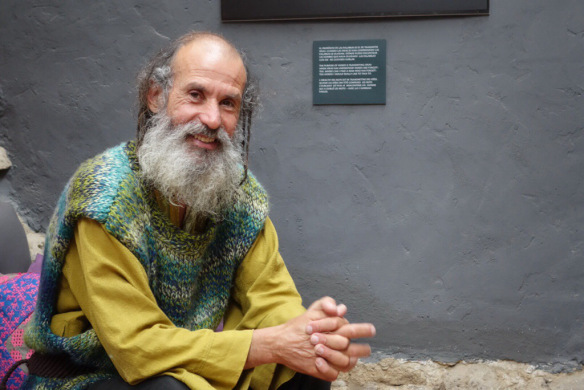


"You are happy to be going home to your family?" he asked.
"Yes and no," I said.  "I am missing them but I am also sad to be leaving this place."  I almost felt like weeping, something I don't do easily.   He just nodded in understanding, and we sat and had our drink.  He is a special human being, gentle and kind and he told me about a visit he's had from his father who he's been estranged from for many years because his father didn't approve of or understand his choice of a way of life that was so different from his own.

Once Mau left I tidied the prayer box, set out the register and the first pilgrim of the day arrived, my first South African!  Well, they are not born and bred South African's but moved to Cape Town from Argentina and call South Africa their home.  She asked if she and her husband, who was struggling along the path behind her, could stay the night.  We are not supposed to keep beds for people on the trail but I couldn't refuse an injured husband with the wife sitting in front of me.  He arrived soon after and they chose their bunk beds.  The Italian pilgrim returned from Mass for his pack and he soon carried on walking to Castrojeriz.

A tour bus arrived and the guide asked if we had seen a group of German pilgrims.  No, we hadn't seen them.  He told us that he had lost a group of pilgrims outside San Anton.  "Is there are bar anywhere here?" asked a German sitting outside the albergue.  "Only 4 km away, at Castrojeriz," I told him.  "That's where they will be, : he said.

Two American pilgrims arrived - a young woman and her older friend.  They asked if they could stay.  Rebecca was thinking of doing a hospitaleros course and I told her that she could also volunteer, arrive a couple of days early and be shown the ropes at the albergue she was assigned to. 

A car pulled up outside and Rebekah Scot and her husband Paddy walked in.  Reb and I had a chat about the albergue, the bed bugs, about Angela and me leaving tomorrow and leaving Kristine on her own.
I introduced her to Rebecca and after a long chat, Rebecca and Lois agreed to spend the next two days with Kristine, after which Reb would join her for the last two days.  The universe had a way of making things right and everyone was happy!

Angela and Kristine returned and Angela told me that we had an appointment with the sisters at 4:00pm.  When we arrived at the convent she rang the bell at the revolving hatch and they passed a key to her for the door on left.  We went upstairs and sat down in a room, separated from another smaller room behind bars.  Soon a few nuns arrived, including two from Kenya and one from Berundi.  We had a great conversation about Africa, our President Zuma, polygamy and politics.  They were interested in my heritage and were surprised to learn that on my mother's side, the Dutch had arrived at the Cape over 400 years ago.  They were happy to provide a prayer box for pilgrims.

We hoped to hitch a lift back to the albergue but all the traffic was going to Castrojeriz so we ended up having to walk the 4km back.  When we arrived back the place was full and we only had two beds left. 

Angela, the South African pilgrim and Kristine started preparing for dinner and as I was signing in a pilgrim I looked up and saw a familiar person walking through the door.  It was Dean, a Ramblers pilgrim from Durban who had come to nearly every Camino workshop of mine since 2002!  He had finally got his act together and was walking his first Camino.  He wasn't sure if I would still be at San Anton and because he was walking quite slowly he was a little behind his planned schedule.
I was delighted to see him and we sat together at dinner so that we could catch up on news. 
This was my last night on the Camino and at San Anton and as I looked around the table at the pilgrims who still had over 450 km to go, I wondered how the Camino would impact on their lives. 
After the last song was sung, the last thank you said to the Camino, and the last prayer request added to the box, I said good bye to Angela and Kristine.  Pedro the taxi guy was coming for me at about 5h45 and I preferred to say goodbye now than wake them up and get them out of bed in the morning.  I left my down jacket for Kristine to use on her Primitivo walk and wished her well.  Angela and I promised to keep in touch.

27 SEPTEMBER - SAN ANTON

 
I got up at 5h15 and quietly carried my big case to the gates.  Then I packed my things into my backpack and whispered good bye to Angela and Kristine.  I closed the gates behind me and walked up to the road.  The walls of the monastery looked different from the outside, the moon shining through the arch that spanned the road.  How many pilgrims have walked through that arch, I wondered?  Millions.  I could almost hear the shuffling of feet and the click-click of walking poles on the road.  The taxi arrived and we were soon speeding along towards Burgos.

I had time to think on the way to Burgos.  Besides the joy of serving pilgrims, very special pilgrims who had chosen to stay at San Anton because they wanted to experience the spirit of the Camino, what lessons had a I learned this time?  I have learned patience, tolerance and endurance, and not to give in to a bossy person, for the sake of peace, on issues that I feel are important or right.  I learned to stand my ground with a smile and not get into any disagreements or arguments. 
I have served with 7 hospitaleros and have fortunately have had a special, happy relationship with all but one - Mrs Bossy.  Even this relationship wasn't doom and gloom, more like stoically enduring constant fault finding and control.  Would I serve with her again?  Probably yes - if we could sit down on day one and agree that there will be no fault finding or bossiness.  They say an apple doesn't fall far from the tree and she has displayed the very qualities that she disliked in her mother.  The fact that she has been on her own for 27 years, raised her children on her own, is an occupational health nurse also contributes to her controlling nature.  She can't help it - in her world she is the boss-lady and she brought that with her to the Camino, and to San Anton. 

Friday, September 25, 2015

25 SEPTEMBER - SAN ANTON

Today was my turn to go to mass at Santa Clara and a small group of us left after breakfast, walking in the early dawn towards Castrojeriz.  There were at least a dozen prayer request in the box this morning and by the time the pilgrims left, only a few remained.  It was gratifying to know that the pilgrims' prayer requests were being taken to Santiago by other pilgrims. 
I had an idea for continuing the prayer requests after the albergue closed next week and chatted to Angela about it on our way to Castrojeriz.  Perhaps the sisters at Santa Clara would be prepared to provide a box in the church where pilgrims could leave their requests, as they did in other churches along the Camino.  I told Angela about the box of prayers in the Church of Santiago in her home town of Logrono and she said she would make an appointment for us to visit the sisters and speak to
them about the ides.
Because we had to wait until 1pm to see the nurse, Angela and I climbed the hill to visit the castle above the village.  When Marion and I visited it in 2007, most of it was off limits and was pretty much just a ruined pile of stones but in the last few years, a lot of money has been spent on the renovation and restoration of the castle.  One can now walk through the castle and see where the small dwellings were.  Climbing the narrow stone stairways gives you a view of four floors of living quarters, kitchens, pantries and water containers.


When we returned to the path in front of the castle we hitched a ride down to the village with a young man.  We walked to the Hotel Jacobus and both of us were able to have a hot shower - my first proper shower in two weeks!  Wonderful to wash your hair under a running stream of hot water instead of in a basin using a plastic cup to rinse!
We walked back to the square and visited Angela's friend, buying a few fresh provisions for albergue.  At 1pm I saw the same nurse at the clinic.  She changed the dressing on my finger and declared it almost healed. 
We returned to the Hotel and I met Ovidio for the first time.  He was busy behind his bar counter but listened avidly as Angela told him about the bed bugs and how we had been dealing with them.  She gave him a list of things we needed, including water, wine, candles, milk, bottled vegetables and fresh, and after half an hour he took us back to the albergue in his car, promising to return later with provisions. 
Kristine went off on her walk and Angela and I tidied the pantry cupboard and fridge so that we would be ready to pack the new provisions when Ovidio returned.  He brought a box of potatoes, onions, tomatoes and cucumber as well as lettuces, a box of bottled salsa sauce, milk and bottles of chickpeas and lentils.  He also brought 5L water bottles and a box of red wine.
That evening Maria Alvarez arrived again, this time bearing a huge tray-box of sweet plums and another of apples for the albergue.  We invited her to stay for dinner and when she told us that it was her birthday, we all sang happy birthday to her.

Thursday, September 24, 2015

24 SEPTEMBER - SAN ANTON

"Don't you think you've cut too much bread?" said Mrs Bossy this morning at breakfast.  "No problem," said I, smiling, "we can toast and left-overs tomorrow or have it for lunch."  There was none left over.  After breakfast, a small group of pilgrims were ready to accompany Angela and Kristine to the Convent for mass before continuing to Castrojeriz. 

https://www.youtube.com/watch?v=fnupacFEPIs

"No lavar los platos!" said Angela (do not wash the dishes).  I wasn't supposed to get the dressing on my finger wet but I pulled on a silicone glove and a plastic glove and was able to wash the dishes, stew the sheets and hang them, wash down the shower walls and floor and mop the two rooms without getting it wet.

Any water left over from the black shower bags or final rinse water went on the herbs and plants.  The herb pots contained rosemary, basil, Italian parsley, oregano and there were tomatoes on the vine, a couple of peppers, a large pumpkin almost ready to pick and zucchinis.  I also watered the Cyprus trees that had been planted in honour of Julian and Jose. 

I had to listen out for the bread van.  He gave a long hoot like a train whistle and if you didn't hustle he could drive off and there would be no bread for the pilgrims. 
" Con pan y vino se anda el Camino"  (with bread and wine we walk the Camino).
No bread would be unthinkable!  I had decided to treat the pilgrims and had ordered two large tuna empanadas (baked pies) for dinner.  

Angela and Kristine returned at around 1:30 pm and shortly after a car arrived with a special visitor for me.  I had never met Maria Alvarez but had heard about the angel who lived in Burgos and spent days standing at a crossroads directing pilgrims around a construction site.  Tom from Jenny's group had met her and when she met Moyra, she told her that she knew a South African called Sylvia from Facebook.  There are many unsung heroes on the Camino who serve pilgrims in their own way.  A cyclist pushed his bike through the gate and up the hill to the albergue.  He looked dehydrated.  "I've cycled too far with no water" he said. "But I have to go on and meet my sister in Castrojeriz."  I poured a glass of water for him and filled his bottle. "Its only 4km to the village" I told him.
"You shouldn't have given him our water" said Mrs Bossy. "The water is meant for us and our pilgrims." 
"All pilgrims are our pilgrims," I replied.  There was always water in the two carafes on the tables outside so giving the cyclist water wouldn't leave us short.  How could we refuse a thirsty pilgrim some water?  If we ever ran out we could boil tap water and fill the bottles for drinking.


The empanadas were golden in their boxes and we were able to heat them by placing them on upturned lids over pots of boiling water.   We decided on a tapa starter with bread, olive oil and balsamic mix to dip bread into, slices of pickled peppers and olives.  Empanada and salad would be our main and we were able to make a fruit salad from a large melon donated by Mau, plums donated by the sisters at the convent, apples and bananas, served with Convent cookies.

The pilgrims told us that this was the best meal they'd had on the Camino!  We told them that a meal like this was only possible through the generosity of the pilgrims who had stayed before them.  If they had been given lentil soup and bread, that might have been because the donations received the day before could not buy anything else! 
The great thing was that we had not had to dip into the donations once since I'd been there and all the shopping was paid for by the donation in the 'sello' cup on the table at the entrance, and from tourists' purchases of trinkets and cards. 

The table is laid out with a carafe of fresh water, a few pottery cups, bowl of fruit or biscuits and a 'sello' (stamp) and a pen to write the date in their credenciales.  Every night when I cleared the donations from the cup, there was always enough to buy at least 8 loaves of bread and eggs for the next day's breakfast.

Breakfast on the Camino usually consists of bread and jam and coffee.  When I did the hospitaleros course with Rebekah Scot, she suggested that we included eggs which were easy to buy and cook, cheap and always appreciated by the pilgrims.  Each morning we boiled eggs which they could either eat or take with them on the trail. 

Monday, September 21, 2015

21 SEPTEMBER - SAN ANTON


With no electricity there are no lights to read by.  With no network , iPads and tablets are kept packed away.  Cell phones come out only to check mileages or information already stored but there are no network jingles or ring tones breaking the silence.  People write in journals, or talk to each other.  At the dinner table, there are lively conversations in different languages including Camino-lingo which involves hand signals, words in other languages or even drawings. We sing songs, share stories and thank the Camino. 
 
At night there is no light pollution to block out or dim the stars and the Milky Way is dazzling with the constellations easily discernible in the night sky - especially with a Google Sky map!  (Technology has its uses in our modern age!)  For the first three nights there was no moon and one could see satellites moving slowly across the sky and follow the trails of shooting stars.  It was magical!!  Then the moon rose and the walls glowed until I didn't need a torch to go to the bathroom at night.
 
For the first few days here I was able to get a cell phone signal and WhatsApp messages if I walked outside the walls or under the arch.  Then the money ran out and I had no way of recharging so I was cut off for over a week.  My world became the daily routine contained between the walls of the monastery. 
 
As I creep through the moonlit courtyard at 6am in the morning, I can imagine what it was like for the Antoine monks who had a daily regime of rising early.  They saw the same moonlight that I now see, opening the large gates into the ruins.  Whilst they had a vaulted ceiling over their heads, I have the stars; whilst they padded inside the monastery on flag-stone floors, my feet crunch on the gravel that covers the courtyard. 

I open the doors to the albergue and light a few candles.  There are lovely comments in the pilgrim comment book.  A rather shy young man has written that he had been searching for the spirit of the Camino and had finally found it here, at San Anton.  I sigh and hold my hand over my heart.
 
The very setting and history in these ruins instil a sense of welcome, healing and tradition  The soaring walls with their Gothic arches and high windows surround and enclose the space that houses the albergue.  The albergue itself, which is grafted onto the ancient walls, is a memorial, dedicated to a beloved brother and friend. I think that this is as close one can get to the soul of the Camino.

There are many prayer requests in the box.  I read a few but there is work to be done.  "Ora et labora" - 'Pray and Work' - the Benedictine motto.  Later, when the pilgrims have all left, whilst mopping the shower and toilet, I think about another of Benedict's rules and of Robert's warning to Kevin and me after we allowed a French couple and their dog to stay for dinner on my second night.  They told us that they had walked from Le Puy en Velay and had now run out of money.  They didn't want to sleep in the albergue (they had a tent), but they were hungry and they would appreciate any food we could give them and their dog.  They would help with any work we needed done.  Of course we let them have dinner and gave the leftovers to the dog; they in turn helped with clearing the table and washing up. 
 
The next morning Robert warned us that the Camino was becoming over-run by freeloaders who used the donativo albergues to their own advantage.  The albergues could not support all the vagabonds on the Camino and if we continued to accept people like these French 'pilgrims', we would be adding to the demise of the Camino. 

He has a point.  Many donativo albergues have had to close or start charging just to survive.  But .....  I think about the man and the woman, and their dog, and once again I think about the rule of Benedict.
 
Let all guests who arrive be received like Christ,
for He is going to say,
"I came as a guest, and you received Me"
And to all let due honor be shown,
especially to the domestics of the faith and to pilgrims.

 
In the reception of the poor and of pilgrims
the greatest care and solicitude should be shown,
because it is especially in them that Christ is received;
 
We had started setting an extra place for 'San Anton' (who at first we called the 'Visitor') and we couldn't find it in our hearts to turn away the late comer, the vagabond - or Christian, a young Spaniard who arrived almost at 7pm a few days later. 
Christian  (imagine me turning away someone with that name?) told me that he was walking to Santiago but as it was the weekend, he had not been able to withdraw money from the bank, so he did not have money for a bed but he would work for food.  I told him that he couldn't sleep in the walls of the ruins, did he have a tent?  No - he didn't have a tent but he was prepared to sleep outside because he couldn't give a donation for a bed.  I told him that many people were not as honest as he was. People who could afford a donation often didn't give one.  I told him to accept our offer of a bed in the spirit in which it was given and in exchange, he could help prepare dinner, take out the trash and wash the dishes.  I thought of Christian often in the following days and wondered how he was getting on. 
 
Kristine is training for her walk on the Salvador and Primtivo in a week's time so after lunch she went on her usual walk.  A car pulled up outside the big gates and Angela arrived.  For 9 years she had served at San Esteban in Castrojeriz but when they started charging 4 years ago she changed to serving at San Anton.  She checked the 'pantry' cupboard and started making a list for tomorrow's shopping.  When I told her that we were out of candles she phoned all the shops in Castrojeriz to find that there weren't any to be had. It was a relief to have someone who could talk on the phone!  I could tell right away that we would get on.  She smiled a lot, asked questions about the albergue, how we were doing, admiring the new fridge and other small changes since her last time here. 
With three of us to prepare dinner, I had a chance to collect bramble berries for our dessert.  Armed with garden gloves and cutters, two pilgrims and I walked down the path and into two fields, collecting the plump, black berries from the hedges.  We crushed some and mixed them with yoghurt and decorated the top with whole berries.
After dinner, Angela asked if one of us would like to go with her to the morning mass at the convent of Santa Clara which was close to Castrojeriz.  Afterwards she would do some shopping in Castrojeriz and visit the hotel.  I suggested that Kristine go this time and I would go the next day. From then on we could take it in turns. 


Thursday, September 10, 2015

10 SEPTEMBER - BELORADO - 12.5 km

When we arrived in Granon I visited the albergue San Juan Bautista where Marion, Annelise and I had stayed and where Jenny served. 

The countryside was brown and showing signs of the drought and heat Spain has experienced in the past few months.

On our way to Belorado we walked through Viloria where I hoped to pop in and say hello to Acacio and Orietta but the albergue looked closed so we continued walking.

We arrived at Belorado and walked through the middle of the town almost to the other end before we found the Hotel Jacobeo on the main road.

There was some confusion about our rooms so we couldn't check in right away.  We decided to revisit the town.


Once we had checked in we asked the owner if we could use the 3rd floor space to have our get-together and at 6pm we all met on the 3rd Floor. 
Jeffrey was still struggling with the light sling pack I had lent him so I offered him Finn's Jeep waist bag.  He tried it on and looked very happy about giving it a go tomorrow.
On our way to a supermecado we found a nice little outside cafe-restaurant for a meal.

Tuesday, January 13, 2015

SANT IAGO - MIRACULOUS MYTHS, FANTASTIC FABLES, AND THE GOLDEN LEGEND


Sant Iago - Miraculous Myths, Fantastic Fables, and the Golden Legend - or "Will the real Santiago please reveal himself!"


Recently I put a post on Facebook listing the numerous places in Europe that claimed to have a relic of St James the Greater.  Santiago wasn't the first town to claim a relic of Saint James - various relics had been around for almost 300 hundred years before he was identified in Spain.

So far I have been able to find three bodies and fifteen heads, two pieces of heads, a number of arms, hands, fingers and other limbs.  I expected to be challenged with denials or disbelief.  But, there has been nothing like that and not one of the 30 or so people who have replied have shown any surprise or contradiction.  

One person wrote, “I don't know about you, but I'm walking to enjoy the spirit of Santiago, and most importantly the Spirit of Christ, whom he loved & served. I'm not walking for random relics or body parts. Just saying. But the research is interesting.” 


Perhaps this reflects what the majority of pilgrims feel about the Camino and about Sant Iago’s relics.  If people don’t know and don’t care, or feel that they do know and still don’t care about the relics being genuine or not, perhaps it is time for the present custodians of the Santiago cathedral to announce to the world that they too have accepted that the legend about the martyred apostle, killer of thousands on two continents is just that, a legend.  What is the point of touting the medieval legend in the 21st century?  

It wasn’t this generation of Santiago church leaders who propagated the legend, or the one that turned the simple fisherman, Apostle of Christ, into an avenging killer, first as a Moor slayer (seen at over 45 battles) and then as an Indian slayer when they took him to the New World.  Ironically, in Peru, the locals turned the iconography of the warrior saint into a killer of Spaniards.
 

 Santiago as a Moorslayer
 Santiago Mataindianos
Santiago MataEspanois
 
Santiago Peregrino 
 

In Spain it is the Moorslayer who they named as their Patron Saint - not the gentle pilgrim we see in stained glass or statues along the Camino.  They, like their medieval counterparts, have perpetuated the myth through the centuries about the apostle Yaakov ben Zebedee’s remains being interred in the cathedral named after him in Compostela and that this is Santiago the Moor Slayer.  What have they got to lose by telling the truth?   I doubt the pilgrim numbers will go down!

The spirit of Saint James the Greater will always be in Santiago de Compostela.  We don’t need a casket containing a collection of unidentified bones to draw us there.  All around the world there are thousands of churches named for Jesus.  None can claim to have a bodily relic but millions of people worship in these churches because His spirit lives there.  

Santiago de Compostela is one of five Holy Cities in Europe, three of them in Spain.  (The other two are Rome and Jerusalem.)  In Spain, Caravaca de la Cruz (Town of the Cross) and Camaleño (the Monastery of Santo Toribio de Liébana) have even more tenuous claims to Jubilee status than Santiago.   

 Santiago de Compostela Cathedral
 Caravaca de la Cruz
Monastery of Santo Toribio de Liébana
 
The Monastery of Santo Toribio de Liébana is one of the most important sites of Roman Catholicism in Europe housing the ‘Lignum Crucis’ believed to be the biggest surviving piece of the true cross.  Tradition has it that Toribio, the bishop of Astorga, brought the piece of the cross measuring 63 centimetres in length and 39 centimetres in width from Jerusalem in the 5th century. In the 8th century, the monks hid the relic in the Liébana valley to protect it from the Moors. Today the cross is embedded in a shrine decorated with gold and silver.


Oscar Solloa, a monk in the monastery, has been asked hundreds of times whether the fragment really comes from the cross on which Jesus was crucified.  'Analysis has confirmed that it comes from a Cyprus[sic] tree in Palestine that was over 2,000 years old, but that is not that important,' he says. 'Many people have found their way back to the faith by coming here.'

Caravaca de la Cruz was granted the privilege to celebrate the jubilee year in perpetuity in 1998 by Pope John Paul II.  It celebrates its jubilee every seven years; the first being in 2003, when it was visited by the then Cardinal Ratzinger who became Pope Benedict XVI.

The Holy relic here is two pieces of wood, also supposedly from the true cross, kept in a reliquary in the shape of a cross with two horizontal arms.  The cross and the wood fragments were given to the town in 1942 by Pope Pius XII to replace a 13th century cross that was stolen in February 1934.  (When the original cross went missing the townsfolk were so afraid of the implications that they dragged the priest into the square and executed him with a single shot to the head!)


The appearance of the original Caravaca cross has an uncertain foundation.  One story is that it was part of a miracle in 1232 when a chamber was flooded with a bright light and two angels appeared carrying a two armed cross containing a piece of the true cross. Overcome by this vision, the Moor steward of the area, Ceyt Abu-Ceyt, who was harassing the local priest, fell to his knees and converted to the Christian faith.  Another is that it was brought from the Holy Land by the Knights Templar, and the other is that it was carried here by the guardians of the true cross which was discovered in Jerusalem by St Helene, mother of Constantine, in the 4th century. 

 
So, here we have three of the world’s five Holy Cities in Spain, each with questionable relics based on miraculous mythology. 

A decapitated apostle is miraculously transported to Iberia in 44AD in a stone boat with no sails, blown across the seas by angels.

Helene Augusta, the ageing mother of Constantine, visits Jerusalem in the 4th century and miraculously discovers the three Calvary crosses. In order to determine which is the cross used to crucify Jesus, she brings a dead girl to the site. When the girl is laid down on top of the True Cross she comes back to life! 
Helene divided the cross leaving a part of it in Jerusalem and had other parts sent to religious leaders in Rome and Constantinople, modern-day Istanbul in Turkey. The first written records of the story of Helene finding the True Cross appear by the end of the fourth century.

This is only one of the legends about the cross; the 13th century Golden Legend, which became a medieval best seller, contains several versions of the discovery of the true cross, but it is the one about Helene that became the favourite in the middle ages.


By the end of the Middle Ages so many churches claimed to possess a piece of the true cross, that in 1543 John Calvin is was quoted as saying that there was enough wood in them to fill a ship.

"There is no abbey so poor as not to have a specimen. In some places there are large fragments, as at the Holy Chapel in Paris, at Poitiers, and at Rome, where a good-sized crucifix is said to have been made of it. In brief, if all the pieces that could be found were collected together, they would make a big ship-load. Yet the Gospel testifies that a single man was able to carry it."
Calvin, Traité Des Reliques.

But, what about the relics of Saint James? 

The cult of Saint James was widespread across Europe and reports of his relics go back to the 6th century.  According to Prof. Leyser, an arm of James the Great was preserved in Torcello near Venice from about the 6th Century.  It passed through the hands of Bishop Vitalis, and then Germany via Archbishop Adalbert of Hamburg-Bremen, the Emperors Henry 1V and Henry V. 

 In 1125 Henry V’s widow Matilda brought the left hand of Saint James to England (there is no proof that she did the pilgrimage to Santiago).  In the early 1190’s a list of over 240 relics in Reading Abbey in England included ‘the hand of Saint James with flesh and bones and the cloth in which it was wrapped’ and this became the most important relic in the abbey with many miracles attributed to it. 

 
The abbey was destroyed by Henry VIII in 1538 during the dissolution of the monasteries and the relic disappeared.  In 1786 workmen digging at Ready Abbey found an old iron chest that contained a mummified hand believed by some to be the relic of Saint James.  It now resides in a glass case at St Peter's Church, Marlow. 

(Reading Medieval Studies by Brian Kemp, University of Reading. Studies in Medieval History presented to R.H.C. Davis: The Pilgrims Guide, CSJ London.)

 In his book “The Cult of Santiago: traditions, myths and pilgrimages” (1927) the Rev. James S. Stone writes about the many relics of St James found in Europe.

In addition to the body at Compostella, a body in St. Sernin at Toulouse and another in the church at Zibili near Milan are equally authentic. There are two of his heads in Venice - one in St. George's church, and the other in the monastery of St. Philip and St. James. A head can be found in Valencia, a fourth head at Amalfi, a fifth head at St. Vaast in Artois as well as part of a head at Pistoja.  In the Church of the Apostles in Rome are preserved a piece of the Apostle's skull and some of his blood. There are bones, hands, and arms in Sicily, on the island of Capri, at Pavia, in Bavaria, at Liege and Cologne, in Segovia, Burgos and elsewhere.” 

According to Armenian tradition, the head of James the Greater is buried in the church of Saint James the Less in Jerusalem and only his body is in Santiago. On the left side of the church, opposite one of the four square piers supporting the vaulted ceiling, is its most important shrine, the small Chapel of St James the Greater. A piece of red marble in front of the altar marks the place where his head is buried, on the reputed site of his beheading. (Church of St James the Less in Jerusalem)


 “In France alone, there were three tombs containing his body, nine heads and numerous limbs.   In 1354 the Saint-Sernin basilica in Toulouse was home to the head and the body of St. Jacques le Majeur.”  www.saint-jacques.info/anglais/spotlights.htm 

“In 1385 the body of St. Jacques was transferred to a luxurious arch-shaped church.  It was the most magnificent reliquary of the church after that of St. Saturnin.” http://ultreia.pagesperso-orange.fr/toulouse.htm 

Even America has a piece of the true cross and a Sant Iago relic.  St James the Less Catholic Church in Wisconsin houses a great collection of relics:  The most precious relics we have are those of the true cross of Our Lord Jesus Christ and of St. James the Less, our Patron. Just a few of the other relics are: ….and St. James the Great, Apostle.”  


In 1589 the relics of Sant Iago in Compostela were hidden to safeguard them from a possible attack by Sir Francis Drake – and were lost for almost 300 years.   They were finally rediscovered in 1879 and were authenticated by Pope Leo X111 five years later as being the genuine remains of the lost saint.  How he did this with no carbon dating or DNA testing is just another one of the mysteries of Saint James!
 
Perhaps the time has come to accept that the legend of James the Greater, and Santiago Mata Moros/ Indianos/ Espanois is just that, medieval legend and myth.  Pilgrims won't stop trekking to gawk at his silver casket or give him a hug!