Showing posts with label Pilgrimage. Show all posts

Thursday, January 08, 2015

Manifesto Villafranca del Bierzo - Part 3


MANIFESTO -Section 3:  Tourism and Pilgrimage

The explosion of the leisure culture on the Camino de Santiago has multiplied the problems already present on the principal routes: the overbuilding, vulgarity, and loss of the unique spirit and values historically associated with the Jacobean Way. Public administrations are to blame for their disingenuous campaigns designed to sell the camino as a “tourism product.”

1.        “The explosion of the leisure culture on the Camino de Santiago..”

What does ‘leisure culture’ mean? 

Even a Google search didn’t come up with a definition of those two words used together. 
Do they mean tourists? 
Or, tourist-pilgrims?
Surely those people who visit the places on the Camino as Religious or Cultural tourists (as pilgrims do to Fatima, Lourdes, Rome or the Holy Land) can’t really be the cause of “vulgarity and the loss of the unique spirit and values historically associated with the Jacobean Way.”
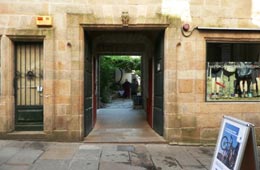
(Photos from Wikipedia)

Do they mean pilgrims or people who walk the Camino but don’t stay in albergues or carry backpacks? 
That is what I have done for the past 4 years and there is nothing leisurely about walking a Camino!  Even if you stay in hotels and have your luggage transported between towns you still have to walk the same rocky paths, in the wind, sun or rain and eat pilgrim food like all the other people on the trail.  You risk the same blisters, tendonitis, shin-splints and muscle cramps.

Do they mean people who take groups of pilgrims on the Camino?  If you've never walked in those shoes you have no idea how challenging that can be!  There have always been 'tour groups' of pilgrims from the first Confraternities to the Knights of Santiago who appointed dozens of people from other countries as official pilgrims guides.  (Like Saint Bona of Pisa: http://en.wikipedia.org/wiki/Bona_of_Pisa )

As far as the Roman Catholic Church is concerned anyone who arrives at the tomb of St James in reverence and prayer is a pilgrim.  The way they get there is irrelevant. The cathedral recorded 12 million pilgrims in 2010.  This is the total number of people who entererd the cathedral during the year for religious reasons. The cathedral uses three  traditional methods for counting:

  • The number of those who go through the Holy Door on the east side of the Cathedral
  • The number of devotional cards issued to anyone who puts a donation in the alms box receives a card.
  • The number of donated communions during the Holy Mass in the Cathedral.
Walking/cycling pilgrims made up only 2% of pilgrims in 2010 according to the numbers who received a Compostela.  I wonder how many of those were considered ’pilgrims‘ using the above criteria?

2.   “ .... and loss of the unique spirit and values historically associated with the Jacobean Way”

 Really?  I really have a problem with this statement! 

The Jacobean Way was never sacrosanct.  It attracted much more than just pious, holy and saintly pilgrims.  Anyone who has read the Liber Sancti Jacobi or any other medieval pilgrim stories will be all too familiar with tales of false pilgrims, thieves, bandits, murderers, vagabonds, heretics, criminal penitents and the vain!  The medieval Jacobean Way and medieval pilgrims are not shining examples for 21st century pilgrims.

“What was even worse was the deplorable state of affairs encountered on the pilgrim routes themselves. Pilgrims by choice or by constraint met up with swarms of unemployed or seasonally employed vagabonds and a veritable horde of beggars. It became ever more difficult to distinguish between the motives of pilgrims on the road.
In 1523 the city council of Bern, which lay on the pilgrim route from Einsiedeln to France decided, to direct away all beggars, be they from the country, returning from the wars or pilgrims on the road to St. James, pedlars, heathens... and such like and not to house them or give them shelter.
Local by-laws throughout Europe, eg in Douai, in Compostela itself (1503) or in Tyrol province in 1532 reflected the same tendency.”

Imagine that, pilgrims not being offered shelter, even in Compostela!

What about the service providers along the Way?

I doubt our private albergue owners are anything as bad as the swindling inn keepers, toll road cheats, murderous tavern owners, false priests, prostitutes, horny young ladies who provided the basis for a legend about chickens miraculously come back to life.  Touts that met pilgrims on the road selling trinkets and souvenirs or trying to con the pilgrims into paying for rooms in already overcrowded inns. And the beggars who walked the Camino on behalf of the penitential pilgrims. 

“Such ‘peregrinatio poenaliter causa’ did as little to enhance the dignity of pilgrims as did the ‘peregrinatio delegata’ which led to beggars  making a living out of accomplishing pilgrimages of penitence in others' stead. (Haebler).

And it wasn't just the poor or mendicant pilgrims who didn't behave.  Robert Plotz describes some of the accounts of the many ‘noble pilgrims’ - those on horseback with retinues:

 The Saxon Duke Henry, later called Henry the Devout, was certainly not attending to his religious needs on his journey to Santiago, for two of his companions reported that, "gourmandising was our best prayer and indulgence on such a journey."  

And how are we to judge or condemn the pilgrim who artlessly tells us how to say "pretty maid, come sleep with me" in the Basque language (A von Harff).

Another new type of pilgrim was the prosperous patricians ... for whom a pilgrimage to Compostela took its place in a journey of information and instruction, a journey on which it was not uncommon to look after business interests too, as did Nicolas Rummel of Nuremberg in 1408/09.”

The ‘Camino’ today (and the person who walks it) is probably more pure, more honest, and the path more sanctified than it has ever been.  There are very few bandits, criminals or murderers lying in wait for unsuspecting pilgrims.  Some restaurants or hotels might overcharge but you don't ever feel that your life is in danger when you stay there!

The great majority of today’s pilgrims – and tourogrinos – are not prompted by a multitude of sins to walk to Santiago. What’s more, they don’t walk in expectation of rewards as did their medieval counterparts.  Many of us have to take at least 4 flights, over 24 hours, at great expense, just to get to Spain and start walking.  And then we do it all over again to get back home.  Surely this makes us  even more admirable - all that effort and suffering for no reward! 

Many people today say that ‘the journey is what is important’ not the destination.  For the medieval pilgrim, the journey was a long and dangerous slog (or a long holiday away from the drudgery of home!) but the thought of not reaching the destination and the expected rewards that awaited them, was unthinkable. 

3.   Public administrations are to blame for their disingenuous campaigns designed to sell the camino as a “tourism product.”

Are they? The first ‘European Cultural Route’ has always been marketed as a tourism product.  Right from the outset the Council of Europe was quite clear that their work was not aimed only at pilgrims but at tourism too.

At the opening of the 1988 Bamberg Congress on the Santiago de Compostela Cultural Route, the address read out for the Secretary General of the Council of Europe, Mr Marcelino Oreja, made it clear that this route was not chosen just to bring pilgrims back, but for cultural purposes too.  

 “The underlying purpose of the process initiated by the Council of Europe: to bring out the historical and cultural contribution made by this pilgrimage movement to the forging of the European cultural identity.  The set of principles and values which represent a heritage common to European nations whatever their geographical location, whether or not these routes pass through them.  For this reason, our work is aimed not only at the pilgrims, who are guided by spiritual motives, but also at those expressing cultural practices peculiar to our own age and society.
As we have pointed out on several occasions, and I should like to do so once again today, the purpose of our work is not merely to revive the Santiago de Compostela pilgrim routes for nostalgic, erudite or archaeological reasons, but also to project them into the future.”
[I stressed words in bold]

Loci Iacobi, a European Union project, aims to develop the pilgrims’ trails of Saint James as a European tourism product and to consolidate it as the first European Cultural Itinerary through the creation and promotion of new tourism contents of high add-value for tourists (and other tourism stakeholders) and through the introduction of the new technologies of information and communication in their consumption"    http://www.saintjamesway.eu//chemins-de-compostelle/loci-iacobi-dr37.html

The pilgrimage road to Santiago has always brought riches and power, especially to Compostela.

"Indeed, for many centuries, it would seem that the chief purpose of St. James was to draw the sin-smitten and disease-afflicted people of Christendom to this distant and secluded part of the world, solely for their spiritual or physical good. Other benefits followed. The constant and increasing flow of pilgrims enriched Compostella, added power and dignity to its rulers, and helped Spain to gain that position in Europe which for no mean length of time made her mighty among the nations."

Rev James Stone - The Cult of Santiago 1927

Is marketing the Camino as a tourism project such a bad thing?   

This is like the tail wagging the dog! 
 
I believe that marketing the Santiago de Compostela route to cultural and religious tourists came first, with walking pilgrims following afterwards.  (Not the other way around)

Remember that for almost 400 years the pilgrimage routes were forgotten, relics of the past. 

Less than 150 years ago, in the Holy Year of 1867, just 40 pilgrims turned up to celebrate the saint's feast day mass on the 25th July.

The late Don Jaime of the Pilgrims Office found an old record book kept by his predecessor which showed that 37 pilgrims received the Compostela in 1967. 

 “In the 1970’s there survived only a remote memory of the Jacobean pilgrimage” wrote Don Elias Valiña Sampedro (father of the modern Camino).  But, he also predicted the invasion!

One day in 1982, with fears of terrorism rife, the sight of yellow arrows painted on trees along a Pyrenean road aroused the suspicion of the Guardia Civil. Following the trail, they came upon a battered white van. A small, smiling man got out. When prompted, he opened the van's back doors to reveal tins of bright yellow paint and a wet paintbrush.
"Identification!" barked the Guardia.
"I'm Don Elías Valiña Sampedro, parish priest of O Cebreiro in Galicia."
"And what are you doing with all this?"
"Preparing a great invasion…"
(Johnnie Walker’s blog)

Santiago de Compostela tourism: 
In a previous post I mentioned the road map of the five road routes that lead tourists and tourist-pilgrims, by road, to Santiago which were published for the 1954 Holy Year.  A concertina style credential was issued, with blank squares so that travelers could obtain a stamp at the places they stopped at along the road and earn a diploma when they arrived in Santiago.  This was clearly aimed at people travelling by motor vehicle and not the foot pilgrims (if there were any.)

In 1971 a book was published by the Ministerio de Informacion y Turismo entitled "Santiago en Espana, Europa y America" (still available on Amazon and ebay.es) 

Robert Plotz writes:
“It describes itself as ‘como una afirmacion del ser historico de Espana’ (as an affirmation of the historical essence of Spain) and also as an invitation ‘a los peregrinos de nuestra epoca que son los turistas ... porque el turismo es una forma moderna de peregrinar’ (to tourists, who are the pilgrims of our age ... because tourism is a modern form of pilgrimage).
Despite its absurdity, the questionable attempt to unite the pilgrim tradition and modern mass tourism, it brought Compostela again to mind as a holy place. 
In the Ano Santo 1965, two million visitors were said to have come and in 1982 the official figure was around six million. These numbers certainly included many pilgrims.  Compostela did not merely gain tourists but pilgrims, who came in ever greater numbers and increasingly in the spirit of pilgrims in the medieval meaning of the term.”  
(Does'nt this tell us that the tourists came first and then the pilgrims followed?)

The road itself (which was arbitrarily decided upon 1984-1987) is not a holy or sacred path. As a World Heritage site it must be preserved but why should it be protected from tourists?  There are numerous monuments, churches, bridges, cathedrals, hospitals along the way, many of them cultural and religious attractions which were awarded World Heritage status years before the 'Camino'.   Most of them charge tourists (and pilgrims) entrance fees.  They are all vigorously promoted to attract tourists – and why not. 

How do they propose to stop or monitor websites like this one?

Spain has so much to offer when it comes to "religious tourism". A few suggestions: follow the Way of Saint James on a pilgrimage to Santiago de Compostela; live the intense Easter Week celebrations; take part in the El Rocío pilgrimage; visit important monasteries and cathedrals, or achieve the "jubilee" (a kind of blessing granted for carrying out certain rites in Santiago).   All while you discover some of Spain's most relevant monuments.  The holy city of Santiago. Santiago de Compostela, in northwestern Spain, is the main destination for religious tourism in Spain and marks the end of the Way of Saint James. Visiting its old town, which has the UNESCO World Heritage designation, and the route of the Way of Saint James, are unique experiences.

The First International Congress on Tourism and Pilgrimages took place in Santiago de Compostela, on 17-20 September 2014.  


The aims were to highlight the positive contributions of pilgrimages and spiritual routes to sustainable and responsible tourism, as well as the contribution of tourism to cultural understanding and the preservation of natural and cultural heritage related to ancient trails and sacred places.  (Full program link at the end of the post).

(Note especially, the reference to ‘spiritual routes’.  Spiritual Tourism is the new big thing in tourism.)  

 “The Secretary of State for Tourism of Spain, Isabel Borrego, recalled that “the city of Santiago de Compostela is a reference for religious tourism in Spain. To visit its historic centre, a UNESCO Heritage Site, and walk the Santiago path are unique experiences. Spain has much to offer in terms of religious tourism”: Santiago, intense pilgrimages and religious celebrations, important monasteries and cathedrals and many religious festivities of great interest.”

At the end of the Congress the “Declaration of Santiago de Compostela on Tourism and Pilgrimages” was read by Marina Diotallevi, Programme Manager, Ethics and Social Responsibility Programme, UNWTO  (Link at the end of this post)
The 5th (and last) proposal was about developing spiritual tourism in a sustainable manner:

“To encourage new initiatives and the creation of international networks that foster the exchange of experiences at the level of research, training of tourism professionals, promotion, marketing and the management of pilgrimage routes and sites, that engage faith groups and local communities as equal partners in developing spiritual tourism in a sustainable manner.”

(".... faith groups and local communities?"   Why were the local guardians of the Camino - AMIGIOS and FICS - not represented at this Congress?)

MANIFESTO:  We agree and propose:

1. Reorient institutional touristic campaigns to build respect for traditional pilgrimage values.

This should also include non-institutional campaigns like the travel and tourist agencies.   

2. Urge associations, confraternities and camino-related organizations to better explain camino values and behavior to new pilgrims.

At our workshops we give all future pilgrims a handout which includes a list of pilgrim and albergue etiquette.  In my planning guide ‘Your Camino’ I included four pages on do’s and don’ts. 

3. Initiate rigorous inspection of all services directed at pilgrims.

This is a bit vague – what does it mean, which services – and who will the inspectors be?

4.  Support and organize programs to open and secure the churches, hermitages and monuments along the pilgrim paths.

Totally agree but hardly possible for churches if you have a circuit priest who is only in certain villages on certain days.  I don’t recall ever seeing a hermitage on any of the Camino routes I’ve walked.  (Maybe I just didn’t recognize the dwellings as such!)
By monuments, do they mean cathedrals, hospices, churches etc?

Perhaps by marketing the pilgrimage as a cultural, spiritual and religious destination for tourists and pilgrims, the Camino might one day change the world!
 
Ben Bowler - Founder World Weavers, Monk for a Month, Interfaith Express & Blood Foundation recently published this article on ‘Spiritual Tourism’.

“Long-time travel industry observer and journalist Mr. Imtiaz Muqbil gave an interesting overview of a tourism industry in transition - moving from what he called the three "S"s of the old tourism - Sun, Sand and Sex towards what he sees as the emerging three "S"s in the new tourism being Serenity, Sustainability and Spirituality.

If this evolution of values in tourism gains traction and is ongoing then there are some serious implications. Considering that tourism is the largest service industry on the planet employing 260 million people, responsible for 9% or the worlds GDP and now having passed the 1 billion mark in arrivals each year, it is not hard to see that even small movements of the needle measuring travelers’ motivations and values can have a big impact on our world. 

In an age of soulless materialism and endless consumption, taking time out to explore the depths of the world's wisdom traditions is probably a good idea. Such "spiritual vacations" may well be a catalyst that brings greater enlightenment to the individual, increased understanding between different cultures and may even help to foster an emerging spiritual renaissance.”


For a biography of the speakers:  
https://www.academia.edu/6325011/INTERNATIONAL_CONFERENCE_ON_SPIRITUAL_TOURISM_FOR_SUSTAINABLE_DEVELOPMENT_Biographies_and_Position_Statements_of_the_Conference_Speakers
Declaration:


Tuesday, May 14, 2013

Lugo and Sarria

I waited for Ivar Revke outside the Hospederia. He brought the box with the 20 copies of Camino Lingo which Paul had sent to Santiago for Reinette. We had a chat and then I called my friend Luis Angel (a Santiago taxi owner) to collect us at 10am to take us to the bus station.  He organised two taxis to take  the 4 of us.
The bus left at 11am and all the way to Lugo we could see pilgrims hiking on the Camino paths. It looks like the Camino is going to be very busy. When we arrived in Lugo we found the taxi rank, loaded our stuff into two taxis and told them to take us to the Hotel Puerta de San Pedro.  The taxi driver looked at us in surprise and pointed to a building about 250m away!  We told one driver to drive the Irish lady and our bags to the hotel across the road and the rest of us walked.

After checking in we walked to the 'gate' in the wall and entered the old city. The Lugo walls are the best preserved complete Roman walls in Spain and one can walk on the top, around the circumference of the walls for about 2.5km.  I got a message from Adrian. His Iberia flight was delayed by 9 hours and he wouldn't be able to meet us in Lugo after all.  He would catch up with us in Sarria instead.

We had a few tapas and drinks then walked to the church and had a look at the Roman baths where hot springs once bubbled up.  We returned to our hotel and decided to order dinner in.  The receptionist, a lovely, accommodating young woman, set a table for us and we phoned a nearby Italian take-away restaurant for dinner. Bob kept us in awe of his stories about his previous Camino walks and in stitches with his lovely sense of humour. After dinner we returned to our rooms and resorted our baggage.
In the morning we dragged our bags across the road to the bus station, bought tickets to Sarria and found the lifts to go downstairs to the platforms.  Our bus left at 12h45 and we arrived in Sarria half an hour later.


We found two taxis to take us to Pension Escalinata.  I had a small daypack with 4 bottles of Amarula and Mrs Balls chutney for Gordon Bell.  I gave one Amarula to Jose and when Gordon arrived, gave him the other bottles. Someone called my name - it was Janet who was sitting with her mother Pat at an outside table.  Not long after, that Adrian arrived. Our Camino Caracoles were all there.
 Belin arrived to take us to the apartments where we would stay for two nights.  Once we were all settled into our rooms - the guys in a room with an en suite shower - Reinette and I went down to the river and found a nice sidewalk café-bar called 'Santiago' where we ordered different tapa dishes for lunch.
That night we went back to the Restaurant Santiago for dinner.  I gave each one a South African beaded badge and a pin as well as the little name magnets I had found in Santiago.  I then started the 'Breaking the Ice' discussion where each one in turn told us their name, what they liked to be called, where they lived, a place they might have lived before and when they had first heard about the Camino.  When it came to Adrian`s turn we listened enthralled as he told us about his extensive experience in the hotel world, living in many different countries around the world where he learned to speak about 8 different languages.  He and his Manchester born wife live in Costa Rica.
I told them that the taxis would pick us up at 8:30am to take us to Barbadelo where we would start walking.  we walked back to the pension, to our respective rooms, all excited about the start of our Slow Camino the next day.

Sunday, August 12, 2012

The Camino is full of Crap. So, what can we do about it?

What would you rather see on the Camino?

This:


OR THIS?


The problem of litter, human faeces and graffiti on the Camino paths has been discussed ad infinitum by pilgrims from around the world on the Camino Forums.  It is a growing problem that needs to be addressed by the organisations in Spain that are responsible for the maintenance of the Camino routes. 

When confronted with this problem on the Camino Forum one pilgrim's response was:   “Shit happens, so perhaps every pilgrim who is given a credencial should, at the same time, be given a packet of biodegradable poop bag kits like "Gotta-go" waste bags or "Go Anywhere" toilet kit so that they can pack and carry their waste until they reach a proper place to flush it away or dispose of it. If people walking their dogs can use doggie poop-bags why can't we?”  

Some say that the litter problem is a pilgrim problem and that it is up to all pilgrims to find a solution.  They have a point - it is after all a 'pilgrim' trail that is walked or cycled by pilgrims from all over the world.
The problem of sanitation however, is seen to be a problem for the Juntas who should provide some type of sanitation facilities for the hundreds of thousands of pilgrims walking the trails every year.
Many pilgrims from outside of Spain have expressed the opinion that with almost 70% of pilgrims being Spanish - and because they are of the opinion that it is mainly Spanish youth groups who litter - the problem of litter and sanitation is a Spanish one. 

When asked for solutions, these have ranged from ‘shoot the buggers’ to ‘name and shame them’.  Some feel that Confraternities should run ‘educational programs’ and others say that hospitaleros should be trained to lecture pilgrims in the albergues on the evils of littering and soiling the Camino paths.  

FAQ:  Where do the pilgrims ‘go’ once they leave the albergue?  Very few Spanish villages and towns have public toilets and pilgrims have to find facilities in cafe-bars or restaurants along the way.  Once out of the village there is nowhere to go so they find places in clearings, behind a tree, bush or bales of hay, sometimes even behind a farmer’s barn or house.  

Gordon Bell (a South African living in Vilacha) says:  “I have a sign at my front door, in my drive way and at the door to the house, explaining that my home is not a public toilet and is not available, but daily we have at least a dozen people begging for a loo and even getting abusive when refused.”

How many pilgrims? 

There are no reliable figures on how many pilgrims are on the Camino at any time. *

A few years ago, Don Juan Jose estimated that the number of pilgrims on the Camino, and the number of pilgrims who receive the Compostela, was about 5 to 1. Over 100 000 pilgrims have received a Compostela so far this year. According to the above estimate, there will be more than 500 000 pilgrims on the Camino this year. Can the Camino trails sustain the litter and, more important, excrement of 500 000 people each year?

* El Instituto de Estudios Turísticos de Galicia y la sociedad de gestión del Plan Xacobeo are hoping to measure the magnitude of the volume of pilgrims and the economic impact of pilgrims.


A growing problem 

In 2002 when I walked the Camino I don’t remember being aware of litter on the paths. I kept a diary and wrote about the Camino every day but I didn’t even mention litter.  

In the 2004 Holy Year there were many places on the Camino, mainly on the last 100km, where pilgrims had used clearings on the sides of the path as toilets. Most of these were littered with used toilet paper and tissues. 

In 2007 my friends and I noticed more litter on the paths than before but it was in 2009 that we realised how the problem of litter and a lack of toilets had affected the Camino Frances. 

In May 2007 a CSJ of SA member Margi Biggs from Cape Town walked from St Jean Pied de Port to Santiago.   “I was really disturbed by the amount of litter left by other pilgrims over the years, so I thought a Camino Spring Clean was in order.”


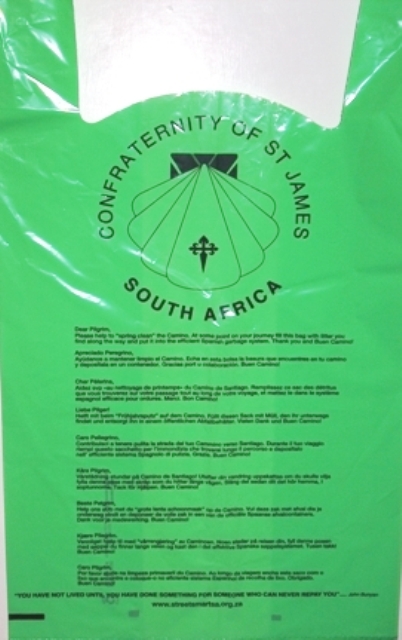
In 2008 Margi launched a ‘Spring Clean the Camino’ campaign and had 10 000 garbage bags (132kgs) printed with the CSJ of SA Logo and a message in several languages asking pilgrims to pick up litter as they walked the Camino. Each South African pilgrim was sent a bag with their credencial and was asked to take the bag on the Camino and help clear up litter along the way.   

In 2008 the Canadian Company of Pilgrims started their litter campaign named ‘Take a Day to Make a Difference’. They decided to include a litter bag with all credencials they issued in 2008 and a request to Take a Day to Make a Difference and collect litter along the way.

October 2008 reports of excessive littering on the Camino continued.

“Hey all, I’m in Leon, I have been walking now for 23 days and I can’t believe how much litter I see the pilgrims leave!!!   Please, walk lightly on this earth, and especially on the Camino. if love my sisters, but I’ve got to say, quit leaving your toilet paper on the ground, especially in all the shady places.....”


In 2009 Margi Biggs and Gordon Bell, a South African living in Vilacha, drove across the Camino Frances leaving piles of bags at albergues for the pilgrims to use. 

The initiative was lauded on the Camino Forums but with a comment that Spain too should take the initiative:

“Excellent! Kudos to the South Africans and Canadians.  With half the pilgrims being from Spain, it would be nice to see Spain lead an on-going anti-litter campaign. I know they do a lot already, but one-time programs from South Africa cannot possibly be as successful as Spanish initiatives.”


Many of the 30+ organisations that belong to the Spanish Federation organise clean-up days of the Camino in their Regions.  But, it is short-lived and the paths are soon covered in litter again.

Every year in December, Rebekah Scott from Moratinos and her little band of volunteers, pick up litter along the Camino in Palencia.  Its a thankless and never-ending job.

January 2009:  “I was also disheartened to see so much litter on the Camino - I mostly saw plastic water bottles and other trash from trailside lunches...often times, there would be a trash can within sight of the litter.”

“In her book The Way of Stars and Stones Wilna Wilkinson arrives at the Cruz de Ferro in the heart of a February hurricane. She describes her disgust as she reaches the top of the great mound of stones to find cigarette packets, used syringes, broken bottles, chewing gum wrappers, bras, condoms, a cast from a broken arm and other 'sacrifices' left at the foot of the cross.”

 In 2009, the American Pilgrims on the Camino Chairman, Jim Eychamer, reported on his visit to the Santiago Pilgrim’s Office where he raised the issue of littering.  Whilst it was agreed that it was a huge problem, Ignacio Santos Cidrás, then director for Xacobeo 2010, was horrified that the US was considering asking their members to take a plastic bag to Spain to help clean up the Camino.  He said that Spain already had a problem with plastic bags in the country and the Americans should not encourage their members to bring anymore into the country.  Unfortunately, he didn’t elaborate on what the solution was and the majority of pilgrims continued to feel that if we are all able to fill just one bag it will be better than doing nothing.  (La Concha - Nov 2009)


December 2010 “An unholy Year on the Camino”.

Greg Dedman, pilgrim friend and collaborator on YOUR CAMINO, walked the Camino in November.  He posted this on the Camino Forum:

“I was disgusted by mountains of litter, desecrated ancient ruins and religious artefacts, pointless graffiti and pile upon pile of human excrement complete with used toilet paper.  From the beginning of the Camino Frances all the way to Santiago, the aforementioned became an unfortunate constant and the more I saw this complete disregard for others, the more upset and angry I became.”


“Throughout the 800km of the Camino Frances litter was a constant eyesore. There’s a whole other argument here for some people regarding whose responsibility it is to clear litter. Numbers of pilgrims in the peak months are sky high and waste bins are few and far between, what bins there are, are sometimes woefully overflowing. However, on a very basic level, walking anywhere in the countryside should mean that you 'take out what you take in' or 'take only photos, leave only footsteps'. Whatever happened to that mantra? “

“For information a glass drinks bottle will take around 2 million years to decompose.
A metal drinks can will take anywhere between 1-1000 years to decompose.  A plastic bottle will NEVER decompose.  Even a banana peel will take a month.”

On one section Greg started counting the number of bottles and cans he could see on the path.

“The truly stunning woodland out of Portomarin was where I chose to start counting. I walked several kilometers counting how many drinks containers I could see just from the path (sad man I hear you say). Not including what went unseen, and the various other types of litter, in just 1km (between km posts 88 and 89) I happened upon 226 plastic water bottles and drinks cans. It may not sound a lot, but add that up over 800km and it’s a hefty sum! (181,000). This was a random section I chose to count but the figures spoke for themselves. What made it worse was that in these places there WERE half-full litter bins dotted along the path!”

Greg described the human waste he saw on the paths.


“I saved the worst for last. I am at a loss to explain simply WHY I and every other pilgrim who walked the Camino Frances after this summer had to be witness to such a disgusting sight time after time. One pilgrim said she read a forum post somewhere (not necessarily here) that advised going to the toilet in the outdoors and not worrying about it as the waste decomposes.  On day two of my Camino, between Roncesvalles and Larasoana I could not find a nice spot off the track for lunch. At every single break in the brush I nipped through to find piles of used toilet roll and human excrement. I didn’t dare sit anywhere nearby for the urine soaking the grass.  This was a constant problem the whole way along the Camino; watch out behind bales of hay in particular. Before Los Arcos there is a little stream, a small bridge and a large pile of bales, lovely spot out of the wind for a rest.... but for the excrement.


On the Meseta things took a turn for the worse. Yes, villages are more spread out here but still, if you do feel the call of nature there are proper ways of disposing of the waste not only to make the way prettier, but also to prevent disease to your fellow pilgrims and other living creatures. As for the toilet roll, come on guys!!!  It can take 2-3 years for toilet paper to decompose (it is designed to decompose quicker in septic tanks, hence putting them down our toilets.)  The time it takes human faeces to decompose can vary drastically!  What is for sure is that it doesn't magically disappear.  With increased numbers of course comes more waste and the clear-up has to happen....180,000 bottles along the route can't remain there for the next 1,000 years right?, someone has to physically pick them up or the entire route will remain a dump for 400 generations.”

The reactions to this post were immediate and varied.


 “I'm an Aussie, and we have public education campaigns against littering e.g. Keep Australia Beautiful. I think it has worked well over the years, though there are still the louts & losers who don't see a problem with rubbishing their country. My questions are - do many other countries have similar campaigns? Is it just the Camino, or is the rest of Spain/Europe getting littered as well? Is it laziness re carrying litter, or culture/ignorance that littering is OK?”

"Some people behave like pigs, or even worse...”
 “This is an appeal to people to NOT use baby wipes, wet wipes, 'moist' toilet paper and the like on the Camino. If you have to do a doody out in nature, normal toilet paper will rot away in a few days, especially if it is the cheapest sort. But the more substantial 'wipes' sit there for MONTHS. It's horrid, it's litter, so please - you can manage without them!”

“I was astounded...absolutely astounded at the number of plastic bottles and pop cans and food wrappers that people left behind...just tossed beside the path. It was beyond me why people couldn't carry their leftovers to the next town, often just a few kms away or even in sight and they still tossed it beside the path.”

Who do the pilgrims blame? 

Nobody ever admits to littering or soiling the countryside - it is always someone else!

“Not to attack Spain, but France is much cleaner along the roads and paths than Spain.”

 “I'd suggest that Southern Europeans are more likely to foul the environment than Western Europeans, based only on (unreliable) observation.”

“More than half the pilgrims are Spanish. I would not be surprised if they accounted for 75% of the litter. I followed a Spanish school group from a vending machine after Sarria. Every wrapping ended up on the ground.

 Over 69% of the 272,313 pilgrims last year were Spanish. We guests should not have to feel guilty about more than 30% of the litter, and probably much less. We might find it difficult to impose an "outside" solution on the litter problem. I cannot imagine that the Spanish are unaware of it. My personal solution will continue to be picking up after myself and a few others, and ignoring the rest.

“Stats are misleading! Especially when the great majority of Spaniards only walk the last 100km. Greg's photos were taken all along the Camino not just the last 100km so we can't sit back and blame it all the crap on the locals!”

“I would guess that the Spanish youth groups probably are one of the prime culprits (but that is also because they are in the majority). Here, it's up to the leaders to give them a pep talk before they leave and, why not, have them sign a pledge not to litter.”

“It's the cyclists.  They buy the 2 litre bottles and toss them aside when empty. Did you ever see a walker buy the big bottles for the trail? The habit of immediate disposal by cyclists carries to every other form of litter. How many pockets have you seen in cycling shorts? My walking shorts have about thirty pockets, more or less, with plenty of room for trash, including crushed water bottles. Bicyclist shorts? No pockets are larger than a key, and certainly they have no room for an empty water bottle.”

“Ladies (yes, especially ladies)... please do NOT leave soiled toilet paper lying along the WAY.”

Other Comments

 “Trash containers are infrequent. Toilets are even rarer. Raging against people going to the bathroom is a fruitless battle.”

“More fundamental is the toilet issue. People have to go somewhere. Nature will call, sometimes when least wanted. Which of us has not been visited by a desperate need along the way sometime, somewhere? The numbers of people and the degradability or not, of what they use, will determine how bad it is. One of the bottom lines is that there are no toilets along the way except maybe in the villages.”

“I have walked in areas, especially where there have been "picnic" areas, where the rubbish/garbage containers were overflowing and waste was everywhere. I really wonder how often they are cleaned up. Every day, week, month - or at the end of the season?


"People won’t stop taking a dump when on the Camino, so the only answer is to leave the path and go a good distance (100 metres or more) and then adopt Rodin's "Thinker" position. Paper can be buried by kicking some earth over it. The offending item is biodegradable compost, and some time later may help to push up some daisies.”

"It´s not a matter of whose it is, whodunnit, or why; it is there, it is offensive, and it needs to be removed. It is that simple; just talking and writing and photographing and complaining about it is not dealing with the problem.”

“If I had a rocket launcher.... But realistically, if you have a plastic shopping bag at the start of the day, and you just pick up trash along the path as you see it, just enough to fill one bag, and you put that bag in a trash bin, well. You´re DOING something about the problem. Enough people do this simple thing (which also gives you a good morning warm-up stretch), and the problem would be on its way to solution.”

“Unless concerted action is undertaken by municipalities, associations and other interest groups, to organize and finance prevention and maintenance, the Camino risks to be an increasing stream of litter.”

“I only found out about the Camino over the last year, and haven't decided if I am ever going to attempt to walk it. This thread alone makes me think "No thanks." Littering? On a pilgrim trail? Tagging all over markers? Really?  and human excrement left out in the open...It's too depressing to even contemplate. What do people undertake this huge physical effort for, only to despoil the environment?”

“The chain supermarkets supply plastic gloves for customers to use when selecting fruits and vegetables. If one isn't picking up too much trash, these can protect one's hands from God-only-knows what germs may lurk on discarded tissues.”

Suggestions from Pilgrims

“Here in New Zealand the tracks like the Milford Track etc have eco toilets at strategic intervals. They are nice looking simple structures which run on solar principles and lead to odourless drying up of poos and pees. The track looks pretty pristine.”

“When 100,000 people get a permit to gather in the U.S., sanitary provisions are made by the government or the group. Spain knows it is getting a mob of pilgrims each year, yet it does nothing to provide toilet facilities for them. The burden is on the bars and the restaurants, and it is an unfair burden. 175,000 pilgrims will spend 30 Euro daily for 33 days. That is about $175m Euro with a lot of VAT and local levies included. Would it kill them to put up and service portable toilets with some of the proceeds?”

“Maybe every pilgrim should be given a small Camino litter bag before they start walking?”

“I think many peregrinos don't know that the big containers you see in the villages/cities are waste containers FREE TO USE. You see at least one in small villages.  That's the system in Spain. Everyone needs to throw their garbage in containers. Easy!!!!  The green ones are general purpose. Just open the cover and throw.”

“I think that it is pretty certain that most of the worst offenders will be staying in albergues for the most part.  Wouldn't it be good if it were made a requirement of checking in at every albergue to sign a "pledge" or "acknowledgment" concerning litter, graffiti, and proper toilet/toilet paper procedures? It would not have to be long...just a pledge not to do it and to protect the Camino.”

“I don't know what the answer is but I would like to see the Spanish involved in keeping the routes clean by creating an anti-litter campaign. It is their country and they must create these rules and enforce them somehow. Now the question is how to motivate them.”

“Setting a personal example always helps. So we must all carry our own rubbish with us, bury our excrement and no defacement (drawings, piles of stones etc) and then we may not even need to start that nasty little English speaking habit of blaming foreigners.”

“Look to Singapore, part of the British empire from 1819 to 1963, as your role model. Caning for littering. Banishment for criticizing the government. It is the cleanest city in the world.”

Suggestion from a Master's Student

Kunaeva Marina, who published her Master’s thesis on“Sustainable Tourism Management along the Camino de Santiago Pilgrimage Routes” in March 2012, suggested that, as a major solution, an environmental impact assessment should take place in accordance with law and this action should be set as a priority when it comes to distribution of financial resource. These measures could be done in cooperation with environmental organizations and volunteers such as:

Consejo Jacobeo – the policy should be equal for the whole route despite of the area where it is located.

Xunta de Galicia – consists of different units and has a direct connection to the government of Spain, consequently has an access to EU sustainability polices.

S.A. de Xestión do Plan Xacobeo– promotes the Camino de Santiago nationally and internationally. It aims at economic and socio-cultural benefits of the Way.

ADEGA – fights, promotes, stimulates for ecological and heritage protection in Galicia region. It has a full awareness of environmental problems.

CETUR – make studies related to economical development on the Camino de Santiago routes in cooperation with S.A. de Xestión do Plan Xacobeo and Xunta de Galicia, thus it has a good knowledge of up to date issues.

Spanish Federation of Associations of Friends of the Camino de Santiago – it represents private initiatives, organises and manages volunteer work that takes place along the Camino.

My Suggestions:

Litter

The organisations in Spain that are charged with the maintenance and preservation of the Camino paths should have a national workshop to discuss this issue.  All service providers and role players should take part.  Once a solution has been proposed, they must engage the support of all the St James organisations and Confraternities by provide articles and documents on their websites which can be used at the pilgrim workshops around the world to encourage their members to be ‘Eco-Pilgrims”.

 If we agree that the problem of litter on the Camino paths is a pilgrim problem, all pilgrims should share in the solution - with the help and support of the Spanish organisations. 

1)   Xacobeo should up-date and improve their brochure ‘Become an Eco Pilgrim’ and every pilgrim who receives a credencial should be given a copy of the brochure and the ADEGA report-back form so that they can report back on environmental damages to the Camino as well as comments and suggestions for improvements.  These could be handed in at the Pilgrim’s Office or posted once they return home.


2)   Nominate one day a week as a ‘Camino-Clean-Up Day’.  On that day, every pilgrim should fill a small plastic bag with rubbish and deposit it in the very efficient Spanish garbage disposal bins.  Plastic bags can be stored in the albergues and hospitaleros trained to hand them out on ‘Camino-Clean-Up Day’.  Posters in the albergues and Tourist Offices will remind pilgrims that “Martes es día de limpieza” in 8 different languages. 

Sanitation

Each Region of the Camino should be responsible for identifying the worst affected areas of the Camino in their area.  These are mainly on long, isolated paths far from towns and villages. 

(South African rural latrine) 


In many countries, ‘Eco - toilets’ have been used in inaccessible areas for generations.  The oldest is the ‘long-drop’ (or pit-toilet) which, when properly constructed, can be used for over 20 years.  Pit-toilets, long-drops and ‘moldering privies’ are used on nature trails such as the Appalachian Trail in the US,  Eco-Trails in New Zealand, in the great Wilderness Game Parks of Southern Africa and the Australian outback.  

This article was written on 2 August:   "When plumbing is but a pipe dream, it's time to dig a pit and build yourself an outhouse"

http://www.cnngo.com/sydney/life/long-drop-australias-outback-dunnies-291535


The modern long-drop has ventilation and windows.

(Picture from www.nachi.org)


Permission to erect eco-toilets in the problem spots on the Camino should be sought from the land owner, who, I’m sure, would be happier to have a sanitary toilet on his land than an unhygienic open air dump.  They are easy and cheap to construct, (± €200) require little maintenance and can last up to 20 years. 


Many years of experimentation and research on the Appalacian Trail, where there are very few villages or towns, has led to the installation of the ‘moldering privy’.    For more info read the ‘Sanitation Manual of the Appalachian Trail in the USA’  http://atfiles.org/files/pdf/atcsanitation.pdf


______________________________________________________


All pilgrim quotes and comments from Greg's post on the Camino Forum:

http://www.caminodesantiago.me/board/el-camino-frances/topic9884.html?sid=2581ab7eaf8a5d17a5054472f12a37b8


Kunaeva Marina’s Master’s thesis on “Sustainable Tourism Management along the Camino de Santiago Pilgrimage Routes”

http://publications.theseus.fi/bitstream/handle/10024/40139/Kunaeva_Marina.pdf?sequence=1