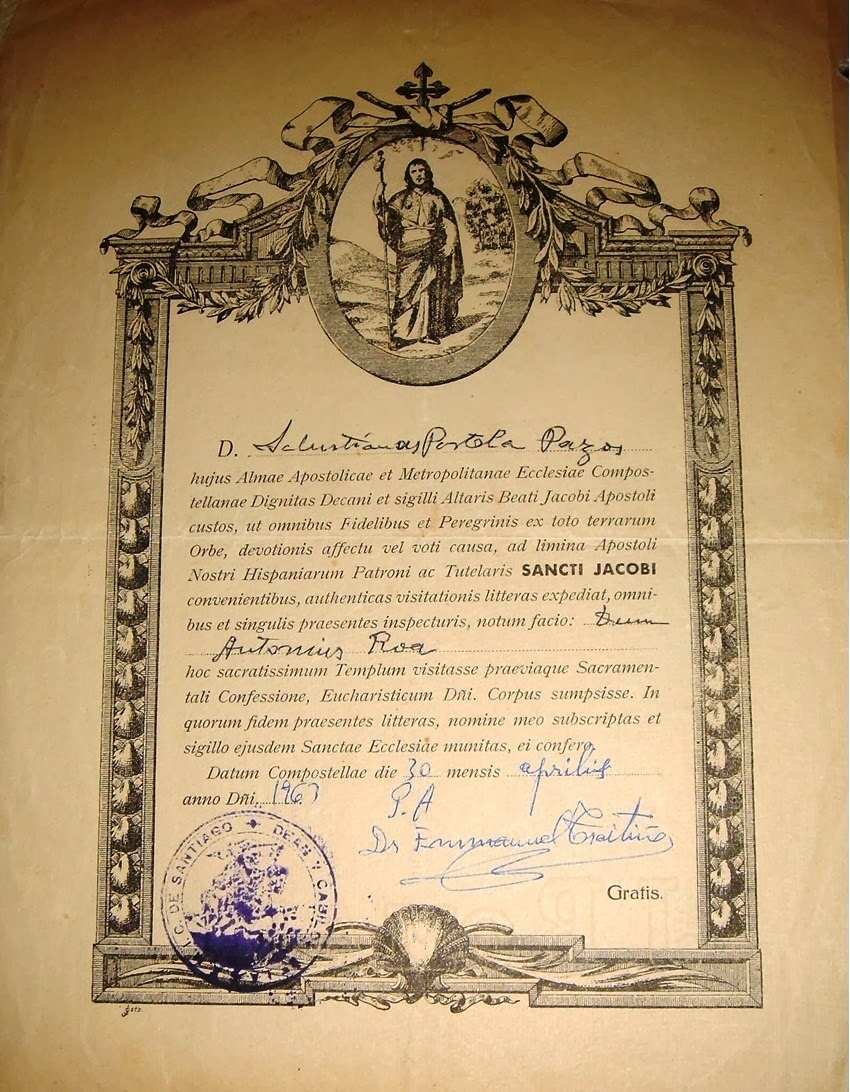
Credencial del Peregrinos
Origins:
The ‘Credencial’ or
pilgrim’s passport evolved from letters of safe passage granted by the church
or state (and sometimes the King) to people going a journey through foreign
lands. Prospective travellers, both clerics
and laymen, combining business with pleasure and/or pilgrimage needed a
‘licencia’ to leave the country. If pilgrims
needed royal protection for their retinue, their lands, possessions and so on,
they would travel with the king’s leave, ‘peregre profeturus cum licencia
regis.’ A pilgrim needed to visit
their priest and make confession before being given a letter stating that he/she is
a bona-fide pilgrim, requesting safe passage, exemption from the payment of
taxes and tolls and hospitality in the monasteries or ‘hospices’ along the way. As late as 1778 King Charles III introduced safe passage documents for both merchants and pilgrims. (This is copy of a safe-passage letter reproduced by the Confraternity of St James in South Africa)
20th century - Spain:
In the late 1950's and early 1960's five road routes leading tourists and pilgrims to Santiago were developed following existing roads. A road map of these routes for pilgrims and tourists was published for the 1954 Holy Year with information on churches, monuments, hotels and restaurants along the way. A credential was issued, with blank squares, so that travelers could obtain a stamp at the places they stopped along the road including Jaca, Valcarlos, Pamplona, Estella, Logroño, Santo Domingo de la Calzada, Burgos, Frómista, Leon,
Astorga, Ponferrada and Monastery of Samos. Once they arrived in Santiago they could ask for the pilgrim diploma which was funded by the Ministry of Information and Tourism and signed by the Archbishop of Compostela. This was issued in the Holy Years of 1965, 1971 and 1976. 428 credenciales were issued to both car and walking pilgrims in 1965 : 451in 1971 and only 240 in 1976.
In 1963, Antonio Roa Irisarri, Jaime Eguaras Echávarri and
José María Jimeno Jurío, members of the newly formed association of
"Los Amigos de Camino de Santiago" in Estella, made a pilgrimage to
Santiago dressed in Capuchin
habits and leading a mule with a wagon. They designed a Pilgrim's
Credential which was approved and blessed by Cardinal-Archbishop of Santiago
Archbishop Fernando Quiroga Palacios.
The cover design with a walking cane, gourd and scallop shell was
adopted at the first international Jacobean conference held in Jaca in 1987.
The
cover was changed in the 2010 Holy year
and this was subsequently replaced in
2012/2013 to celebrate the Ano de la Fe.
A new cover was designed in 2013

The modern
pilgrim no longer needs to be a Catholic, or make confession, or even get a
letter from a church to be accepted as a pilgrim. They will need an official ‘Credencial del
Peregrino’ to stay in the network of pilgrim shelters, refugios and albergues
on the Camino routes. The official
Spanish credencial is printed by the Cathedral of Santiago and is available
from various parishes, bishoprics and associations along the Camino
routes. Only those walking, cycling or
riding horseback are accepted in the pilgrim shelters. The credencial is
concertina type folding card with squares for rubber stamps collected along the
way.
Pilgrims are required to obtain stamps in their credencial, proving that
they have complied with the requirements for earning the Compostela certificate
given to those who walk or ride the last 100km, and those who cycle the last
200 km to Santiago. (In 1965 the church began to issue a special certificate to those who trekked at least 300 km on foot. The certificate entitled the pilgrim to free lodging and meals for three days in Santiago but pilgrims complained that the church authorities treated them with little regard).

With the
formation of St James associations in other countries, new versions of the
credencial del peregrino were issued.
Soon, many tour
companies offering Camino bus, or vehicle supported tours, started printing their
own credencials and bus pilgrims who stopped at various albergues or bars to get a stamp in the credencial were arriving in Santiago to claim a
Compostela. This prompted the authorities to restrict the acceptance of credenciales to the official church document and
those offered by affiliated St James organizations.
AT the time, Genaro Cebrian Franco, Canonic of
Pilgrimages wrote:
“For a long time the pilgrim document was the signed
and sealed letter from his/her parish attesting to the intentions of the
pilgrim.”
On 14 September 2000, at a meeting of the Santiago Archdiocese, the
Archconfraternity, and the Federation of Friends of Santiago Associations, an
accord was reached regarding future Pilgrimage-related measures.
Because of the large growth in pilgrim numbers (In 2000 the number of pilgrims
earning the Compostela 55,004, and in 2007 it was 114,026) and the increase in
commercial credentials, the need for one uniform pilgrim’s credential was
recognized, and agreed upon.
Many more arrived at the Pilgrims’ office with credentials issued by
non-recognized.
“Commencing on January 1, 2009, the Pilgrims’ Office
will only accept the credential issued by the Santiago Cathedral, which has a
space for the seal of the authorized institution, church or Santiago Friends’ Association
that issued it.
Friends Associations that are not part of the Federation of Associations that
may wish to issue credentials must contact its parish to obtain the information
that must be imparted to those who wish to make the pilgrimage. Through their
parish they may obtain a sufficient number of blank credential forms.
For the purposes of granting the Compostela at the Pilgrims’ Office only the
credential issued by the Cathedral, or by those that are issued by Friends of
Santiago Associations that clearly contain information about the religious
character of the Santiago pilgrimage, will be accepted.”
In
addition, if you're starting in Galicia it is important to get 2 stamps per day in
your credencial.
The other credencial
that is accepted is the University credencial:
CREDENCIAL JACOBEA UNIVERSITARIA In 2002 the Alumni Association of the
University of Navarre and Spanish universities located on the Camino Frances launched
an imitative to promote the Camino de Santiago between the university communities
internationally. With this credential pilgrims can also stay in the albergues
and earn the Compostela in Santiago. You can apply through https://www.unav.es/alumni/campusstellae/solicita.html If
you want University Compostela sent to you,by post or e-mail it is necessary
to send the original or a photocopy of the stamped Jacobean University
Credential with stamps of different universities visited along the Camino, and
at least two stamps per day as well as the stamp of the Pilgrim Office in Santiago
de Compostela. More information
http://www.campus-stellae.org
When the pilgrim arrives in Santiago
they visit the Pilgrim’s Office in Rua do Vilar where the ‘AMIGOS’ will check
the stamps in the credencial and, if they have sufficient stamps and can attest
to having walked the Camino for a religious/spiritual reason, they will earn
the coveted Compostela certificate. This
is based on a 14th century document, in Latin with their name
written on it in Latin too. If they have walked the Camino for reasons other than religious/spiritual, they receive a different certificate.
LA COMPOSTELA: > 1321

Many people confuse the Compostela with an Indulgence. The Compostela is not a 'get-out-of jail-card', it is a certificate of completion awarded to pilgrims who walk or horseback ride the last 100km to Santiago de Compostela, or cycle the last 200km. The Indulgence (for the remission of sins and time spent in purgatory) is given to Catholic pilgrims only who comply with the requirements of visiting the cathedral (you don't have to walk the Camino), recite a prayer, such as the Creed o Lord's prayer, praying for His Holiness the Pope; attend mass and receive the Sacraments of confession.
The 'La Autentica' (as it was first called) was originally an 18" X 20" parchment, hand-written in Latin with a small wooden Santiago pilgrim attached to its upper left corner. A requirement for earning this document was confession and communion (but this requirement seems to have been stopped from the 18th century). The oldest copy available is dated 1321 and can be found in the archives of the Pas-de-Calais in northern France.
Before the "Autentica", pilgrims collected a scallop
shell as proof of their pilgrimage to Santiago. (Paper was costly and scarce). When the name changed to the 'Compostelana' during the transition between the handwritten document and the advent of printing (which only reached Galicia in 17th century), there were two documents issued - one handwritten, carrying a 'Bula' or seal, and a printed one. There were many forgeries of this document which prompted the pope to threaten excommunication of anyone was found to be in possession of a forgery. One can imagine a group of pilgrim friends travelling to Gascony, having a good time and drinking wine. They buy a forged Compostelana and travel back to England after a nice long holiday in the sun!
After the decline in pilgrimages from the 15th century, it seems that the issue of a certificate stopped for a few centuries, was revived in the 18th century and then stopped again at the end of the 19th century.
When Walter Starkie walked to Santiago in the 1920's, 1930's and 1950's
he wrote in his book The Road to Santiago about collecting his scallop shell before continuing to the cathedral.
"We proceeded along the narrow streets to the offices of the
Confraternity of St. James and I was given my scallop shell, which for
eleven-hundred years had been the badge of kings, prelates and beggars
alike."
18th century Compostelas

In the early 20th century, Cardinal José María Martín Herrera encouraged the return of organized pilgrim groups to Santiago. A medal replaced the Compostela in Holy Years (which saved printing costs and earned them some money). These were only issued in the Holy Years of 1909, 1915, 1920 and 1926.
For many years thereafter, pilgrimage was affected by the Spanish Civil War and in 1938, the Compostelana bore the words of Franco - "Prince of Spain and its supreme leader of the army."
In the late 1950's and early 1960's pilgrims who travelled on the newly established tourist roads in Spain, could claim the 'diploma' once they arrived in
Santiago. This was issued in the Holy Years of 1965, 1971 and 1976.
In 1963 three members of the newly formed association of "Los Amigos de Camino de Santiago" in Estella made a pilgrimage to Santiago. They are warmly received and were issued with the new Compostelana certificates. The wording was different from the previous certificates: "Certifying pilgrims will be true pilgrims, not thugs or homeless, received wide acceptance in the Hospital of Reyes Católicos".
Until 1965 there was a special Maritime Compostela for pilgrims who sailed 40
nautical miles to Padron and then walked to Santiago from there.
Some stats claim that in 1974 only 6 Compostelas were issued. Records prior to the 1970's were lost.
1976 Compostela
In 1985 the name of the certificate was officially changed from a Compostelana to the Compostela.
When the pilgrim arrives in Santiago they visit the Pilgrim’s Office in Rua do Vilar where the ‘AMIGOS’ will check the stamps in the credencial and, if they have sufficient stamps and can attest to having walked the last 100km (cycled the last 200km) or a religious/spiritual reason, they will earn the coveted Compostela certificate. This is based on the 14th century document, in Latin with their name written on it in Latin. If you have walked the required distance for any other reason you will be give the 'tourist' certificate. Those who continue to Finisterre will also earn the Fisterana. And, if you walk to Muxia or Padron, you will earn their certificates as well.
Today one can download and print a 'virtual' Compostela from the cathedral
website:
You can also apply for a memorial Compostela for a departed pilgrim.
The Compostela and the Tourist certificates have been upgraded and the latest versions will by added here as soon as they become available.
March 2014:
Certificate of Distance:
The Pilgrims' Office started offering two new services. In addition to the traditional Compostela and Certificate of Welcome which are still issued on a donativo basis the Pilgrims' Office is now offering a Certificate of Distance. This new certificate has been produced in response to requests from pilgrims. It records the route which the pilgrim walked, the starting point, the amount of kilometres and the date of arrival in Santiago. The cost is E3.
Read more: http://www.johnniewalker-santiago.blogspot.com
New Service for Organised Groups
The Pilgrims' Office is offering to prepare Compostelas and Certificates in advance for organised groups so that they can avoid waiting in the queue at the Pilgrims' Office. If anyone wishes to use this service the group leader should email the Pilgrims' Office and they will be sent a form to fill in on behalf of the pilgrims in the group. The Compostelas/Certificates will be ready for them on arrival. In addition to this the Pilgrims' Office will also issue a certificate in the name of the group as a whole and will arrange to have the group welcomed by name at the beginning of the Pilgrims' Mass. This is a free service and donations are invited for the Compostela/Certificates.
Information on credentials and Compostelas from the website of Fernando Lalanda - with permission.
and - The 'Historia-Descripción Arqueológica de la basílica Compostelana ,
published in 1870,




.jpg)


-tile.jpg)