Showing posts with label camino ingles. Show all posts

Tuesday, September 15, 2015

SEPTEMBER - SAN ANTON


A basic pilgrim shelter was first established in the ruins of San Antonin in 2002 but due to lack of volunteers was often closed.  In 2006 Julian Campo and Jose Santiago, hospitaleros and well known personalities in Castrojeriz, were killed in a train accident on their way home from walking the Camino Portuguese.  Julian's brother, Ovidio Campo who owns a hotel in Castrojeriz, restored and improved the old shelter in their honour.


The monastery hospital of San Anton was run by French Antoine monks who had similar monastery hospitals in France and Italy.  They were places of healing where people suffering from the medieval disease known as San Anthony's Fire, were sent to be cured.

San Anthony's Fire was a disease caused mainly by eating mouldy rye.  In times of famine, poor people would eat the mouldy cereals and develop ergotism which led to the sufferers going berserk and caused gangrene of the hands and feet due to constriction of blood supply to the extremities. Many were healed at San Anton and miracles were attributed to the Saint.  Good food, lots of sunshine and care might also have had something to do with their recovery!

In Spain San Anton is always seen with a piglet.  He was a lover of animals and once a year, San Anton's day celebrates animals, much like Saint Francis in Italy. 
At San Anton the donations are placed in a Piggy Bank. 

The medieval Gothic builders must have had a sense of humour because the added a piglet in stone to one of the high arches on the inside of the cathedral.  When we show people they are delighted when they manage to spot the little stone pig high up near the top of the ruin.


Wednesday, September 02, 2015

ON THE ROAD AGAIN - September 2015

One more sleep and I will leave for Spain to walk a short section of the Camino Frances with a group of pilgrims, and serve as a hospitalera in a pilgrim shelter for two weeks.

amaWalkers Camino has 6 groups walking the Camino this year - 4 on the 'Best of Both' Camino Frances route from St Jean to Santiago, and 2 on the 'Complete Your Camino' from Logrono. 
Marion is leading the September 'Complete Your Camino' and I will walk with her and the group as far as Burgos where I will leave them to go to the ruined monastery of San Anton where I will serve in a small shelter for 12 pilgrims until 27th September.


Marion and me on the Camino Ingles - 2009

Marion is an experienced Camino trekker.  We met in 1997 at the start of a 50km walk from Inchanga to Durban.  We walked the route together and remained friends.  In 2000 we ran the Comrades marathon together.  In 2001 we walked the Coast to Coast in England, in 2006 the Via Francigena from Switzerland to Rome, in 2007 the Camino Frances from Roncesvalles to Santiago and in 2009 from Lourdes to Pamplona on the Aragones route and the Camino Ingles from Ferrol to Santiago.  Next year amaWalkers is leading 4 groups on the Via Francigena and Marion will be one of the group leaders. 

We meet in Logrono on Friday.  The rest of the group should all be there by Saturday and we have planned a visit to the castle of Clavijo on Sunday, about 18km south of Logrono, where Saint James was first seen as Santiago on a white horse, brandishing his sword at the battle between Christians and Moors, slaying thousands of the enemy. The legend was first written about 300 years after the supposed battle took place and is one of the many legends of Saint James and Santiago.


Santo Domingo de Silos - home of  Gregorian Chant

On Monday we will start walking westward towards Santiago stopping at Navarrete, Najera, Santo Domingo de la Calzada, Belorado, San Jaun de Ortega and Burgos.  I will leave the group in Burgos and they will have an overnight excursion to Santo Domingo de Silos where the monks made Gregorian chant famous in the 1990s.  They return to Burgos the next day and continue walking west for 15 more days, leaving out the sections they walked when doing the 'Best of Both' Camino and arriving in Santiago on 27th September. 

The atmospheric pilgrim shelter at San Anton was created in 2002 by Ovid Field who has a pension in Castrojeriz.  It sleeps 12 pilgrims in 6 double bunks and has beds for 3 hospitaleros in a container, tucked under the ruined walls.  Many shelters in the middle ages catered for 12 pilgrims which is symbolic of the number of apostles.  There is no electricity and no running water. 
This is the notice I received about the shelter: 


"THIS IS A VERY LAID-BACK PLACE. There is no strict schedule and no real “rules” except a ban on smoking indoors, littering, drug use, excessive noise, and the ever-present water shortage.
This is a DONATIVO albergue. No one is turned away for lack of funds, and we do not make any suggestions regarding how much a stay is worth. Show the pilgrims where the donativo box is, put it on the table at breakfast time, and leave it at that.   

Gates are open from 8 a.m to 10 p.m. Anyone can come or go during that time, you should give everyone a smile and a welcome.  Groups of people CANNOT line up to use the toilet, as we do not have water capacity for that.  Pilgrims can take rests at San Anton, but no one can use the shower who is not staying overnight. No camping is allowed. Animals are admitted according to your judgement; owner is to clean up after them.

You are expected to make a dinner each day for pilgrims, using the simple ingredients on hand. The stove is a four-burner, powered with Butane. Have someone show you how to change the butane bottle if you don’t know how – it isn’t hard, but there is a knack to it.  The kitchen is pretty well equipped to serve 12. Be sure to find out if you have vegetarian guests before you start cooking! Breakfast is served at 7 or 7:30 am., nothing elaborate.
We would like to make a special effort this year to maintain the niches in the arch across the road outside. The Antonine monks who lived at San Anton used to leave food out there for pilgrims who arrived after the gates were closed. They now are used by pilgrims as a place to leave little offerings, prayer requests, or notes of thanksgiving. Please keep them orderly; replace faded flowers, pull weeds, etc. If so inclined, offer prayers for the requests left there. "

Kevin Duke from Durban is serving there from the 1 - 15 September and I'm looking forward to spending a couple of days with him during the hand over.

I will arrive in Santiago on 27th September and will meet up with 6 peregrinas from Jon's 'Best of Both' group.  We are flying to Barcelona the next day and will spend a night there.  Viator tickets for a guided tour of the Sagrada Familia have been booked. 


When we visited last year the queue was so long that we couldn't get inside and I'm making sure that this time we will skip the queues and spend time inside the cathedral.
This is going to be a very different Camino experience for me as it will be the first time in 10 Caminos that I won't be walking into Santiago.  But, there are many layers to the Camino and each one has been different, each one offering a unique experience.
Roll on Friday!!


Friday, June 13, 2014

13th June - Mino

We walked around the Ria and over a 116 arch bridge into Pontedeume. Bob's daypack was falling apart so we found a Chinese Bazaar (our preferred stores for cheap goods) where he bought a new pack. Then it was up, up, up to the church of Santiago which was closed, but we were able to get a sello.
Up, up and up we went again until we crested the ridge above the town.
Our destination today was Mino, about 9 km away. We knew about the hill out of Pontedeume but didn't expect another Kilimanjaro beyond the golf course. It seems that the Camino paths have to go as high as they can before they drop down again to virtually sea-level.
One thing we have learned is to be prepared with food and drink as there might not be anywhere to stop for either between places. This is not like the Camino Frances with cafe bars almost every 5km.
Marlene had developed ugly blisters but I think the Compeed I bought her in Cabanas might be doing their bit and she coped with the long ups and equally long down hills.
We stopped for a picnic in the playground opposite the church and were a bit perturbed to find condoms in the playground!
When we artived in Mino we discovered that the Hostal Brisa was 2.2 km out of town up hill on the N165. We decided to take a taxi. The Hostal owner, Monty, reminded us of 'Ramon' in the movie The Way, eccentric, forgetful and, as the afternoon progressed, he became completely drunk!
On first indpection the rooms looked comfortable but the net curtains were in tatters, the bath towels threadbare and the hook for the towel in our room fell off as soon as Finn hung it up.
We ordered dinner for 7pm and at 8:30 pm Carmen (the wife) arrived back from the supermarket and started cooking! I gave up and went to bed. The others ate after 9pm.  Finn woke me at mid-night with painful reflux. I wasn't surprised after having eaten a large potato tortilla before going to bed.

Wednesday, June 11, 2014

2014 Camino Caracoles - el Ferrol to Neda

We met in the cafeteria at 8am after leaving our luggage and paying for the accommodation. We were all sending extra baggage ahead and I had booked Jacotrans to transfer 5 bags each day.  Finn and I were supposed to share the pink suitcase, Marlene would have the khaki kit bag, Gail her suitcase, Bob a duffle bag and Penny a suitcase. They quoted me €5 per bag per day.
When Finn and I packed the pink bag (which Kathy and I had shared and was now half empty) Finn found that he couldn't get all his stuff into it. We decided that we should buy another bag for him but he would share the khaki bag with Marlene for one day.  I emailed Jacotrans to let them know that we would have an extra bag from Thursday and that I would put another €40 in an envelope for them. They replied that they wouldn't charge us extra for the 6th bag. So, we got one bag for free!
At breakfast I read some of the first day's stage from Johnnie Walker's notes. I asked each one why the were Caracoles. Penny - because she was very slow: Bob because he will be 90 years old in 3 month's time: Finn because he has peripheral neuropathy,  Gail because she has 'funny' feet, Marlene because of her childhood polio and me because I'm walking with my broken arm in a cast. What an odd group we are!
We were all a little nervous starting out and we took a photo of the first Camino sign we saw. Johnnie's signs and route descriptions were easy to follow. When we had gone about 5 km we stopped at a cafeteria for a drink and Mercedes, the waitress, was so delighted to see us she brought us free Madelena cake and little chocolates. Our first Camino angel.
There was a Chinese Bazaar across the road so Gail, Marlene and I went to look for a bag. Marlene ended up buying a new suitcase on wheels which she and Gail carried between them for a while. Then Gail took over caring for Penny by carring her pack and Finn carried the suitcase.
It took us almost 7 hours to walk to Neda and by the time we got there - about 11km - we were all hot, tired and ready to stop.
For about 2km you can see where you have come from and wish you had a boat to save you all that mileage!
The Hostal Maragoto is run by a friendly mother and daughter and the rooms are comfortable but ours was 51 steps up! After checking in and lugging the cases upstairs,  I went down to ask for the wifi password.  Back up again we did some washing then went down to ask about dinner. Back up again and so it went on. Straight after dinner I was prone on the bed!

Tuesday, June 10, 2014

Astorga and el Ferrol - 10 June

After Kathy left I updated the blog, sent a few emails and sorted out my ticket to Astorga and el Ferrol. I had to drag the pink bag over the river pebble bridge, picking it up to carry it over the worst of the stones. 

I got to the bus stop on the main road in time for the 10 am bus. It was a 20 min ride to Astorga and i decided to walk around the cathedral rather than drag the case up the steps between the Gaudi Palace and the cathedral.
I visited the tourist office and sat down at the outdoor cafe next to the cathedral for breakfast. It costs more to eat at outside than inside but I wanted to be visible for Kathy when she arrived. Janet from the Uk saw me and stopped for a chat.  Just then Kathy arrived.u
She had toast and coffee and then we walked to the bus station.  Who should we bump into there but Patty from Portland and Sharon. Patty had to rest a couple of days so they are playing catch up and will tak a bus.
The bus was 20 mins late and each time an Alsa bus pulled in I asked the driver if this was the bus to Ferrol. Eventually my bus arrived and I said good-bye and Buen Camino to Kathy.  Her bus to Villafranca was leaving after 2pm so she didn't have long to wait.
The bus was half empty. Soon we passed  Villafranca and I recognized the castle from the road. We had a 20min stop at Ponferrada where many people got off.
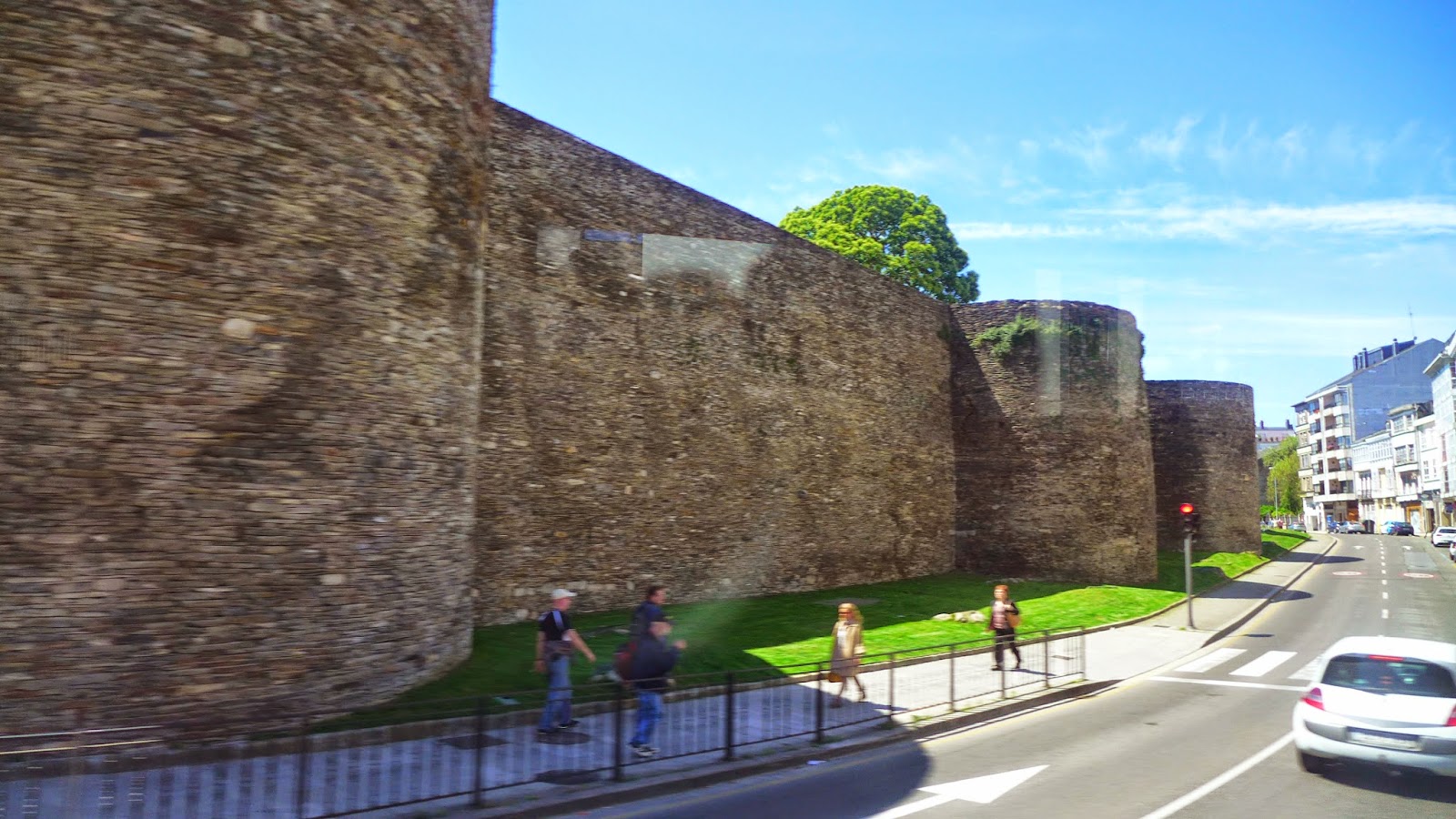
We stopped at Lugo and I was able to take a photograph of the walls through the window.
 We made up time and arrived in Ferrol on time at 17h30. I got a taxi to the hotel - just around the corner but I didnt want to drag the pink case up a flight of steps and along the road.
When I got out of the taxi I saw Finn and Uncle Bob sitting in the hotel cafeteria,  then I saw Gail, Marlene and Penelope. We had a happy reunion and Penny, who speaks excellent Spanish, asked the hotel to recommend places to eat. Finn took me to our room, a hot, stuffy, almost windowless room. It is one of those where the electricty switches off when you remove the card to leave the room. After unpacking and rearranging some stuff for tomorrow we went out to eat.
We found a nice little restaurant (that didn't offer a peregrino menu) and then returned to the hotel.

Monday, June 02, 2014

1 June - Castrojeriz

I had to get a taxi here as there are no buses from Hornillos.
 Tomorrow there is a bus but only at 6pm.  I don't fancy spending another long day here so will have to cough up and pay for another taxi to Fomista. Thereafter,  I will be able to take Alsa buses all the way to Astorga.
It was too early to check in so I strolled around this sleepy village, even more sleepy being a Sunday.  Even the few bored dogs I saw didn't lift their heads when I passed them.
The town is a waren of narrow,  stony alleys and steps wrapped around the base of the hill.  At the top is the ruin of an old castle. In 2007 Marion and I climbed to the top to see the castle and the stunning views.  But, I wasn't going to risk going up there on my own. If I tripped or fell I could die of hyperthermia before anyone found me!
I walked back to the Meson and my room was ready and my pink case waiting for me.

 In 2002 when I walked with Georgette and Clare, we stayed in an awful albergue in concrete cubby-holes with
thin vinyl mattresses. You couldn'nt sit up and we nearly froze to death. In 2004 Joy and I stayed in this Meson and in 2007 Marion, Annelise and i stayed in the San Esteban albergue then a few weeks later, after Finn joined us to walk from Sarria we hired a car and I drove us here from Oviedo.
I walked downstairs and saw Kathy checking in.  The sun was out and it was quite warm. We decided to have a mixed salad for lunch in the terrace area but it had been reserved for a first Communion celebration so we were seated inside the dining room.
After lunch I tried out the sitting bath but had to stand and shower. I was afraid that if I sat down I wouldn't be able to get up and would need rescuing!
I decided to take a walk to the shop which, according to their sign, would open at 4.30pm.   Kathy was also looking for it but only a bar was open. I bought some dates and an iced tea and we went back to our rooms.
There are two things pilgrims search for when arriving in a village or town - a place to sleep and the for food. I'm sure the bakeries, cheese makers, ham producers and breweries survive through the pilgrim trade.
We went in search of an open shop and found others doing the same.  The film producer of the documentary on the cellist - 'Walk to Fisterra' - was looking for peanut butter to feed his crew in the morning. Dane Johansen is playing here tonight.

On the way back we stopped and chatted to the couple from Belgium and outside the Meson we ran into the Aussie family and talked about Comrades (which was run today).
It doesn't get dark until about 10 pm so when you go to bed you have to close the shutters or roll down the blinds.


Monday, May 12, 2014

'Complete Your Camino' recce walk

amaWalkers Camino offer 22-day walks on three sections of the Camino Frances.  When we first planned the sections in 2010, most people wanted to start in St Jean and finish in Santiago so that they could earn a Compostela.  This meant splitting the 775km route into three sections.  We decided on walking 9 days from St Jean to Logrono, getting a bus to Burgos, Leon and Astorga then walking in the Irago Mountains and Bierzo Valley to Villafranca del Bierzo or Ambasmestas before being taxied over the Cebreiro hill to Samos and walking the last 130km to Santiago. This means walking almost half of the Camino Frances.

Over the last 3 years, many of those who have walked the amaWalkers Camino 22-day walk have asked if we could offer them a walk to 'Complete' their Camino by walking the sections they missed.  When I sent a suggested route to them - from Logrono to Astorga and Ambasmestas to Sarria - many asked if they could either continue walking to Santiago on a different route or walk to Finisterre from Santiago.  We agreed to offer both short routes as possible endings to their 'Complete Your Camino' walks in 2015.

Although I have walked the Camino Frances a few times, and have done the Camino Ingles and Finisterre route, I didn't stay in hotels and walked as little or for as long as I felt like doing each day.  When you plan for a group walk, you need consistent daily distances of about 20km and accommodation in pensions, hostales, hotels etc.  So, we need to walk the route again and check out the accommodation along the way.

From 25th May my friend Kathy and I  will do a reconnaissance walk of the new routes.  We will both walk the section from Logrono to Astorga, crossing the beautiful meseta.   Kathy will then get a bus to Villafranca del Bierzo and walk from there to Sarria.  I will get a bus to Ferrol and walk the Camino Ingles to Santiago. 

When I put this plan on Facebook, a few people asked if they could join me on the Camino Ingles walk, so now there are 6 of us, including 90 year-old 'Uncle Bob' from California, my husband, cousin, sister-in-law and Penelope from Oregon.  We will walk ± 10km per day from Ferrol to Santiago in 11 days.  Accommodation has been booked ahead and we will use luggage transfers.

In September, amaWalkers co-director and Group Leader Jenny Rooks, will do a 4 day recce walk from Santiago to Finisterre.   Once we have walked all of these sections, estimated daily stages, transport possibilities and checked the accommodations we will offer the walks in May 2015.

I am leaving in 8 days time and will arrive in Spain on 21st May. Before Kathy arrives I will be visiting friends we have made of hotel, pension, B&B and Gite owners in St Jean, Viscarret, Zubiri, Estella and Logroño. 

I am not well prepared for this walk.  A month ago I got Shingles on my face and scalp which knocked the stuffing out of me. Then I had to go on a diabolical drug to reduce a swelling in my right retina.  The side effects include dizziness, nausea and reflux, diarrhea and pins and needles in the tongue and fingers.  I haven't been able to do any long walks for over 5 weeks.  I will finish this medication 3 days before I fly from Durban and I'm hoping and praying that most of it will be out of my system before I go. 


Thursday, November 03, 2011

PILGRIM FOOTPRINTS

Lives of great men all remind us
We can make our lives sublime,
And, departing, leave behind us
Footprints on the sand of time.

I have a confession to make!
I've written another book - about the Camino. 
I keep asking people not to write about their Camino  - unless it has a fresh or unique angle, perhaps about a different route (there are dozens of books written about the Camino Frances), or if it was an unusual journey.  Perhaps they walked with their dog, or with their children.  Maybe they walked as a mendicant in medieval garb - that would make interesting reading.
There are so many books being published about a walk on the Camino Frances that although they can  be inspirational, they have become almost formulaic and could be told in 10 lines.  They have the  same  landscape, same villages, same albergues, same experiences, same food, same pilgrims.  If you have read as many pilgrim books as I have, you'll know what I mean.

I promised myself I wouldn't write a Camino book - about myself.  So I wrote one about someone else!  Its not anyone you'll know because he lived in England in the 12th century and I made up the story about his pilgrimage to Santiago.   

I first had the idea for this book in 2001 when I joined the Confraternity of St James in the UK and bought a little metal scallop shell brooch.  It is a replica of a  15th century souvenir of a pilgrimage to Santiago, made of pewter, which was recovered in the banks of the river Thames near London Bridge.
It features St James, dressed as a pilgrim, against the scallop-shell emblem.  When I first saw the brooch I wondered how on earth such an intrinsically sentimental, valuable pilgrim badge had landed up in the river.  A pilgrim, presumably from England, had made the long and dangerous journey to Spain in the Middle Ages, bringing back this beautiful little souvenir.  He must have valued it greatly and yet it was dug up on the bank of the river.  

At the time I did some research on Santiago artifacts found in the River Thames and was lead to an article in 'Peregrinations' on the website of the Kenyon university. 

"The “core” collection of the Museum of London (finds that do not come from formal archaeological excavation) consists of 1021 medieval badges, of which 739 are pilgrim signs and the rest are secular badges. Of the 739 pilgrim signs, 45% have the Thames as the find spot, with most of the remainder from riverside sites [John Clark; pers. comm.].  

So how did the brooch get into the the river?

"Unfortunately, there are no accounts in contemporary literature that describe pilgrims disposing of their signs in rivers. Assuming that this is deliberate, it is likely that there was no single motivating factor, rather many reasons for doing this. In the archaeological literature pertaining to pilgrim signs, it has been suggested that this was sort of an offering of thanksgiving for a safe return from the dangerous journey [Spencer 1998]."

I am a Romantic so I decided to write  story around the little metal brooch - or rather, around the original pewter Santiago souvenir.  I played around with a few ideas - male pilgrim, female pilgrim?  Or both? English pilgrims? Where from?  Checked the Domesday book for likely villages.  After a few days of searching villages I settled on one in the south of England, not far from London, that has a fantastic page on the village in the middle ages.  It provides descriptions of the dwellings, the number of people, their industries, village life, their clothing, their religion and names of 12th and 13th century people buried in the church-yard of the Holy Trinity Church.   I found a record of my pilgrim's grave on the website and decided to write the story around him.

Yay!  I had a name, I knew where he lived, what his home looked like and what he did.  I invented his family, including deceased grand-parents, a sister who died at a young age, two older sisters, a younger brother and an uncle.  But I couldn't decide what my main protagonist looked like.   One day I was watching a cricket match and decided that my pilgrim looked like Andrew Flintoff! I don't know why Andy Flintoff but he looked so - English - that I decided my pilgrim would look like him. 
I started doing research into the middle-ages, especially the 12th century. I opened up a folder for each letter of the alphabet and started saving articles - everything from Abelard to Witches.  In the meantime in 2002 I walked the Camino Frances from Roncesvalles to Santiago and collected as many leaflets and brochures as I could from every place we visited, posting them home when I'd filled an A5 envelope.  When I got home I had 7 envelopes full of literature - much of it in Spanish.  The next year I spent a small fortune on books. Our libraries didn't have much on the Camino, there wasn't much on the Internet either 10 years ago, but I could buy books. I bought books on pilgrimage, medieval Europe, on the History of London, a gazetteer on French towns, historical books on the Santiago pilgrimage and Confraternity papers from the Confraternity of St James and the CD Pilgrims & Pilgrimage - Journey, Spirituality and Daily Life through the Centuries. This is an Interactive CD showing the importance of pilgrimage in the Middle Ages and beyond through word and image.  

By the end of 2003 I knew my characters intimately and I had a synopsis of the full plot of the story. The crux of the story starts with a mystery - a question in a recurring dream. My characters go on a penitential pilgrimage to Santiago from April to August in 1178. They ride to Dover, get a boat across the channel and ride to Paris. From there they ride to Santiago and back. In between are plots and sub-plots, Knights, highwaymen, thieves, murderers, a forbidden love affair, a poisonous night that changes their lives forever. The ending provides the answer to the dream. 

In 2004 I visited London and made an appointment with John Clark, curator of the medieval gallery in the Museum of London. He showed me a tray of Santiago souvenirs and other pilgrimage artifacts. I also got to see the original pewter brooch which was the inspiration for my story. I felt as though I'd owned that souvenir!
In June and July that year I walked from Paris to Roncesvalles, in the footsteps of my characters. They were with me all the way and I tried to see things through eyes - no mean feat when half of the monuments, churches, bridges, castles and so forth described in 'The Pilgrim's Guide to Santiago de Compostela" are no longer there! But it was a wonderful experience and once again I sent home bundles of envelopes filled with leaflets, brochures and booklets on the places along the way.  

In 2005 I finished the first draft and handed it over to my Creative Writing teacher (who also happened to be one of the only South African literary agents listed in the Writers and Artists Handbook).  After two days she called.  "Syl - I'm not going to read your manuscript, " she said.  "You have written your story in the first person and it is very restricting.  I'm suggesting you re-write it in the third person so that all the characters can be fleshed out. Then you can bring it back to me and we'll see what we can do with it."

AAAARGHHHH!!!!  I was devastated.  Crushed. Three years of work and I had to re-write it all!  By then I was busy with other things.  I was planning to walk the Via Francigena.  I filed the manuscript away.  I walked the VF in 2006. The next year I walked the Camino Frances again.  In 2009 I walked the Aragones route, and the Camino Ingles, and worked as a hospitalero in Corcubion. 

Later that year Francis became ill and sadly passed away.  I'd lost a friend, a tutor and a Literary Agent. I decided to haul out the manuscript again and started working on it.  Its not that easy to change a story from the first person to the third person.  "I" becomes "he" - "we" becomes 'they".  My character did a lot of thinking and "I thought" had to become "He thought". 

In 2010 I started writing 'Your Camino" - a planning guide for people wanting to walk or ride a Camino route in France and Spain. It is a 330-page encyclopedia of information and it has been published by Pilgrimage Publications in France.   In between two more walks in Spain, I have spent most of this year rewriting "Pilgrim Footprints". I have sent off proposals to agents and publishers, have had two rejections, but am waiting to hear from the others.  Book publishing has changed a lot in 10 years and if I don't find a publisher, I may consider self-publishing or making it available as an eBook.  
Watch this space!

Monday, October 03, 2011

YOUR CAMINO gets good reviews

YAY!!!  My book, "YOUR CAMINO on foot, bicycle or horseback in France and Spain" is getting good reviews on the forums and online book stores.

This review on Amazon.co.uk:

YOUR CAMINO - a Lightfoot Guide to Practical Preparation for a Pilgrimage (Paperback)
Preparing for a Camino and the thought of the challenge ahead can be a daunting task. This guide is akin to a reassuring, extremely informative and wise friend! Forget about trawling through every Camino book and website for the guidance you need - these experienced authors have done it all for you!
This is a vast accumulation of well researched knowledge all set out in a very logical format, offering sound advice in manageable chunks of text.

It covers the very basics (which you'll be surprised to find you may not have considered!) to the more in depth and complicated with handy highlighted tips and basic photographs where a visual reference is needed.
As if this isn't enough, further reading and useful websites for each topic dealt with are also detailed while the appendices elaborate on some important points such as post-Camino blues, Camino lingo and a training programme! Interesting historical detail and inspirational short stories from ex-pilgrims wet the appetite for adventure while the humorous cartoons remind you to keep a sense of humour during the serious job of planning.
I bought this book to satisfy my curiosity in the Camino de Santiago and my occasional ponderings on walking the route myself.
 I intended to dip in and out of it as I needed but ended up reading it from cover to cover! It tackles every practicality you could possibly think of, giving encouragement to every type of person, and is truly motivational, whether you have decided to walk a Camino yet or not. I wouldn't say this guide is only for first timers. It provides invaluable support for everyone.
Although the book focuses on routes to Santiago through France and Spain, it would serve equally
well as a guide to preparation for any other pilgrimage route.


And this one on a Camino Forum:
I've made time to read, and thoroughly enjoy, Sil's new book "YOUR CAMINO" and I can't imagine a more practically helpful publication for any pilgrim. Sil has covered virtually every eventuality and need of the pilgrimage, and her advice is rendered as though she were a kindly and wise mentor for anyone who ever planned to make the dream of the Camino become a personal, and permanent reality.

Saturday, March 26, 2011

YOUR CAMINO

Your Camino – on foot, bicycle, or horseback – in France and Spain.


After years of answering frequently asked questions on Camino forums, the Internet, Camino workshops and on this blog, I have written a book with the answers to thousands of FAQs in a book called ‘Your Camino – on foot, bicycle or horseback, in France and Spain’.

Besides providing information and maps on the many different Camino routes in France and Spain (with links to Jacobean routes in other countries) it offers advice on the best time to go and how to get there, planning daily stages, budgets and accommodation, pilgrim and trail etiquette.  Last year I enlisted the help of Greg Dedman (Camino pilgrim and backpacking expert) to help with chapters on technology, weather, food and language. Many other experienced pilgrims have shared their expertise on subjects as diverse as disabled pilgrims, cycling, trekking with children, horses, donkeys and dogs.
There are chapters on clothing and equipment covering boots, shoes, backpacks and sleeping bags, as well as medical matters, relics, Santiago Holy Years and pilgrim statistics.


Illustrated with delightful pilgrim characters by Sandi Beukes, this 280-page reference guide covers everything from learning about the Camino on the Internet, books and DVDs, Confraternities and Forums, to taking a donkey on the trail, and how to ‘go’ in the woods!

This will be a must have book for anyone planning their first, or second or third Camino and an invaluable resource for organisations that offer advice and help to pilgrims planning their Caminos.

‘Your Camino – on foot, bicycle, or horseback – in France and Spain’ soon to be published by Pilgrimage Publications.  http://www.pilgrimagepublications.com/

Sunday, December 20, 2009

PILGRIMAGE PIE

A year ago, I wrote a post titled 'Back to the Past' where I challenged the idea that the camino was being spoiled by becoming too popular. 

The road to Santiago was one of the most popular Christian pilgrimage destinations for hundreds of years. It suffered during the Reformation, the Wars of Religion, the Napoleonic Wars and after the industrial revolution. It is now slowly clawing its way back to its former glory years.


El Pais reports that the camino is returning more and more to its medieval past and villages, towns, municipalities and individuals are vying for a slice of the lucrative pilgrimage pie. (This post is a translation of that article with a few comments by me in brackets).


"We take bags to the next hostel for two euros," reads a sign on the door of a bar in Triacastela.

In another block nearby, the owner has removed his animals and has replaced them with a half-dozen vending machines offering sandwiches and hot coffee and dressings for blisters.

Sarria, in Lugo, now holds the record in Galicia with 8 pilgrim refuges  (not quite as many as the 32 shelters that once floursihed in Burgos)

Some places will charge you $5 for a breakfast of muffins packed in industiral plastic or $25 to sleep in a room in a private home, and you will be grateful because 500 people seeking to stay in a village of 100 inhabitants is common, especially in summer.

The rise of the pilgrimage to Compostela has brought back a new golden age to the Camino de Santiago and, as it did in the Middle Ages, the populations through which it transits are being transformed.

As there was in the past, there is a big fuss about this opportunism.
As far back as 1133 the authorities of Compostela admonished traders after finding pilgrim money was being paid over to residents. A few years later, the bishop instructed Gelmírez to channel water to a source in the northern facade of the cathedral to stop the greed of the landlords who attempted to charge pilgrims for water.

Yellow Arrows
Today the signs of the French Way are well established, but at the beginning of this boom there were some who diverted the yellow arrows so that the  'Jacobean Mana' would pass the front door of their bar or hotel.
The truth is that there are more people wandering in the wilds of the steppes of Castile, with unique names such as El Burgo Ranero or Hermanillos Calzadilla, than there are people entering the route to Santiago on the National Road.
In Rabanal del Camino, a tiny town in the mountains of Leon, there are four hostels for pilgrims, two hotels and a country house.
Take the paradigmatic case of Foncebadón, a town of Leon abandoned and in disrepair for at least a century, which has already opened three shelters, an inn and a restaurant with a medieval letter.
All this has resulted in extra comfort for the pilgrim. A few years ago the daily walking itinerary had to be carefully planned because the stages were far apart and places to eat and stay overnight were scarce. Today, the number of pilgrim hostels scattered throughout the French Way numbers 254.

Shelters
If there is anything that identifies the Camino de Santiago and makes it unlike any other route it is the hiker's world of exclusive network of shelters for pilgrims. This is a legacy of that tradition of hospitality which allowed medieval travelers to get around the world.  Only those pilgrims on foot, bicycle or horse who hold the credential of a pilgrim (a kind of passport issued by churches, associations and even their own shelters) allowing them to sleep in these shelters.  Authenticated by the owners of the shelter they avoid being overun by sneak vacationers in search of cheaper accommodation.

But even here the road has changed. The shelters started off being managed by the Church, municipalities and associations of Friends of the Way and were mainly 'donativo.   But there are very few donativo left shelters and some pilgrims even take advantage of the donation box (and leave nothing for its upkeep).
Like the sign put up by a priest (in Granon) which says "Pilgrim, give what you can, take what you need" - these are now just a nostalgic memory. Typically, shelters now vask for a fixed price (three to five euros) except a few honorable cases, such as shelters run by the Federation of Friends of the Camino de Santiago, who remain faithful to the donation system.

Private shelters

Given the massive influx of pilgrims and the shortage of places in these public shelters a new class of establishment has emerged - the private hostel. They are pseudo-shelters with services for the walker, gradually being regulated by law, which offer accommodation in bunk beds, heating, hot water and various services at a fixed price, which typically ranges between seven and ten euros. Most offer the same spirit of welcome to the piglrims, in areas where there was none before, and are good value for money. But there are also those who see pilgrims as business travelers, without room for hospitality. A private hostel in Hospital de Órbigo denied entry to a pilgrim at seven pm on a winter's night because he could not pay the stipulated seven euros.


Compostella or certificate of welcome

Pilgrims who arrived in Santiago and demonstrate by producing the stamped credential that they have completed the last 100 kms on foot (200kms on horseback or by bike) are awarded the Compostela a document of completiton in Latin. The precurser to the Compostela was a scallop shell which could only be purchased in Santiago but a rudimentary certification system of letters of proof evolved over the centuries. With the current flood of heterodoxy, the Church wants to bring back the religious character of the pilgrimage. Now, on arrival at the reception office of the cathedral, the pilgrim is asked about motivation. If you are religious, you are granted the Compostela. If you are otherwise, you are given a certificate of welcome in Spanish.

The yellow arrow

Marking each and every one of the crossings and detours along nearly 800 kms of route with yellow arrows seems impossible. But it has been acheived. It started in the eighties with D. Elias Valiña, parish priest of O Cebreiro who, with a bucket of yellow paint and a brush, painted arrows on the mountain. This was taken up and continued by administrations and volunteers of associations of Friends of the Way. Today you can walk from Roncesvalles to Santiago without fear of getting lost. From the 2004 Jacobean Holy Year detours were etablished to avoid those sections that remained along the side of roads.

Other Routes
All this happens in the most famous French route, the busiest since antiquity. It starts in Roncesvalles (Somport in Aragonese ) and passes through Pamplona, Logroño, Burgos and Leon before crossing O Cebreiro into Galicia. But there are many other ways that have improved significantly since the 2004 Xacobeo. Historic routes, used formerley by medieval travelers and now, in the slipstream of the success of French, are being put in use.


Camino Portuguese
Chief among these is the Camino Portuguese where the first yellow arrow is found on the facade of the Cathedral of Lisbon. It is a unique opportunity to learn a different Portugal, on foot or by cycle paths, historic sites and remote villages off limits to those traveling by car. From the Tagus to Lisbon Santarém back and then continues to the great monastery of Tomar, Coimbra, Porto and Vila do Conde, to enter Galicia at Tuy. It is also marked, but has the same shortage of shelters on the Portuguese side as in the last Xacobeo - only three.

Camino del Norte

The next in number of pilgrims, the Camino del Norte, a favorite to do in summer. It starts at Irun and follows the Cantabrian coast, the sea to the right and the green mountains on the left. A delight, passing through San Sebastian, Bilbao, Santander, Oviedo where it divides into two:.  The Coast continues to Gijón, Avilés and Ribadeo, and the Primitivo goes inland to Grandas, Asturias and Lugo. It is very well marked and the number of shelters has grown dramatically since 2004.
Via de la Plata

The Via de la Plata traces several ancient Roman roads that connected with Seville via Astorga, Extremadura and Castilla y Leon. It has also greatly improved its layout and signage since 2004.
Others...
The English Way (A Coruña- or Ferrol to Santiago), the Camino de Finisterre, and from Cape Finisterre to visit the Santo Cristo de Fisterra, and the sanctuary of A Barca, in Muxía, the Camino de Alava, the Camino de Madrid, Soria, the Ebro Valley ..